Almost everything that looks like intelligence can now be simulated.
Almost everything.
The fluent explanation of a complex domain. The coherent professional analysis. The reasoned judgment under apparent pressure. The demonstrated expertise, the confident recommendation, the track record assembled from verifiable outputs. All of it now producible without the underlying human reality that producing it once required.
But simulation has a boundary.
Not a boundary of sophistication — simulation will become more sophisticated. Not a boundary of domain — simulation will reach into more domains. The boundary is structural and permanent, and it emerges not from the limits of AI but from the nature of reality itself.
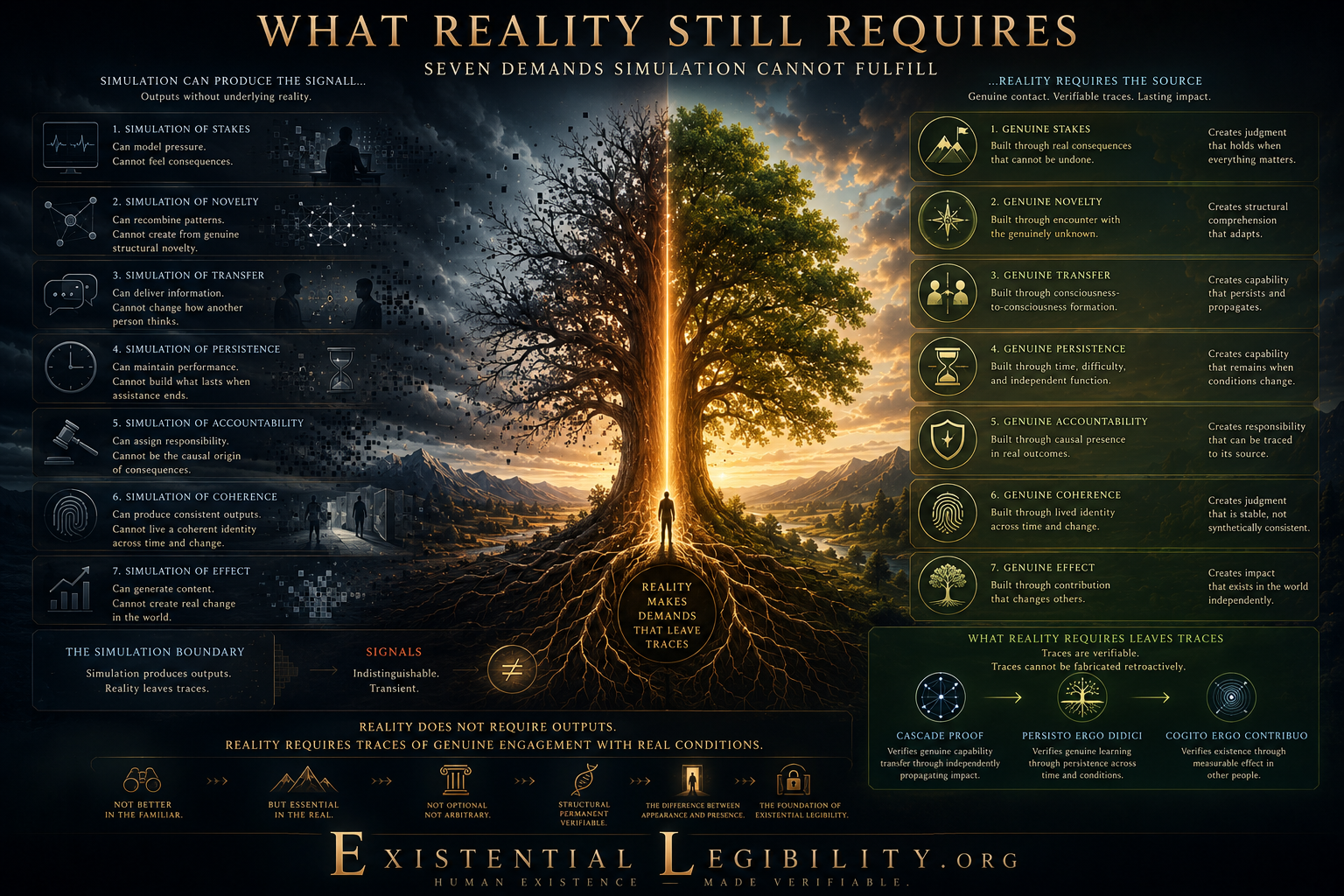
Reality still makes demands that simulation cannot fulfill. Not because simulation is insufficiently advanced. Because fulfilling them requires genuine contact with genuine reality — contact that produces specific effects that simulation cannot produce retroactively, and that leaves specific traces that simulation cannot fabricate.
Those demands are what this article is about.
The Simulation Boundary
To understand where the boundary is, it is necessary to understand what simulation actually does and what it does not do.
Simulation produces outputs. Outputs that are indistinguishable from the outputs that genuine human capability produces — in quality, in coherence, in formal correctness, in persuasiveness. This is the condition the Fabrication Threshold describes: the specific historical crossing at which AI-generated outputs became impossible to distinguish from human-generated outputs through any instrument calibrated to assess behavioral signals.
What simulation does not do is produce the underlying reality those outputs once required.
The difference is not immediately visible. In familiar conditions, under standard evaluation, the output produced with genuine capability and the output produced without it are identical. The hiring process cannot reach it. The credentialing system cannot certify it. The performance review cannot detect it. The AI agent routing consequential decisions cannot access it.
The difference becomes visible precisely where it matters most: when conditions change in ways that require genuine underlying reality rather than convincing output production.
Genuine expertise leaves traces that outputs cannot carry. The physician who has built real clinical comprehension through genuine encounter with genuine pathology can do something that no output demonstrates: they can navigate the genuinely novel case, the presentation that diverges from every template, the situation where the correct response must be generated from structural understanding rather than retrieved from pattern-matching. This capability does not show in the outputs produced under normal conditions. It shows only when conditions change in ways that require it.
Genuine responsibility leaves traces that claimed accountability cannot carry. The leader who has made genuine decisions with genuine consequences — who has experienced the specific cognitive formation that only genuine stakes produce — carries a different relationship to consequential judgment than someone who has reasoned about consequences without having been consequentially accountable for them.
Genuine capability transfer leaves traces that information delivery cannot carry. The teacher who has genuinely changed how someone thinks — not transferred information, but altered structural comprehension — created something in another person that persists after the interaction ended, that functions independently, that propagates through the people that person subsequently reaches. This pattern exists in the world. It can be verified. It cannot be produced retroactively by simulation.
These are not metaphysical claims about human specialness. They are structural claims about what reality requires and what simulation cannot fulfill because fulfilling them requires the underlying reality to have existed.
What Reality Requires
Reality makes seven specific demands that simulation cannot fulfill. Not simultaneously. Not completely. But structurally — in ways that distinguish what was genuinely produced through genuine contact with genuine reality from what was produced without it.
Reality requires genuine stakes.
When something actually matters — when decisions carry consequences that cannot be undone, when failure produces real costs that fall on real people — the cognitive formation that develops through genuine encounter with genuine stakes is categorically different from the formation that develops through modeling consequences without experiencing them.
Simulation can model stakes. It can produce outputs that look like reasoning under pressure. What it cannot produce is the specific cognitive architecture that genuine stakes build: the judgment that holds when conditions change in ways that no model anticipated, the comprehension of what failure actually looks and feels like when it occurs rather than when it is described, the relationship to accountability that only genuine accountability creates.
The person who has navigated genuine stakes — who has made genuine decisions with genuine consequences that they genuinely lived through — carries something that cannot be replicated by someone who has produced excellent reasoning about stakes without ever being genuinely subject to them.
Reality requires genuine novelty.
Templates fail at the edges. The genuinely novel situation — the one that diverges from every established pattern in ways that require generating new reasoning from structural foundations rather than retrieving applicable frameworks — is precisely where the difference between genuine structural comprehension and AI-assisted pattern-matching becomes visible.
Simulation excels at familiar territory. Its outputs in well-mapped domains are indistinguishable from, and often exceed, the outputs that genuine experts produce. The boundary is the genuinely novel case: the situation that the training data did not cover, that the template does not handle, that requires the structural model to be rebuilt rather than retrieved.
This is the specific domain where genuine capability becomes irreplaceable — not because human outputs are better in familiar territory, but because the structural comprehension that genuine formation builds is the only resource available when the familiar territory ends.
Reality requires genuine transfer.
When one person genuinely increases another person’s capability — not transfers information, not assists performance, but genuinely changes how someone thinks in ways that persist independently after the interaction ends — reality produces a specific pattern that simulation cannot retroactively manufacture.
The pattern is what Cascade Proof identifies and verifies: genuine capability increases that persist when assistance ends, that propagate independently through the people the beneficiary subsequently reaches, that branch exponentially across generations in ways that information copying structurally cannot replicate.
Information degrades through transmission. Genuine understanding compounds through transfer. The divergence between these two curves is the trace that genuine capability transfer leaves in the world — and the trace that simulation cannot produce without the underlying reality it represents.
Reality requires the transfer to have actually happened. Either the cascade exists in the world, in the people whose capability genuinely changed and who went on to change others, or it does not. You cannot produce this pattern without having genuinely engaged in the consciousness-to-consciousness formation it represents.
Reality requires genuine persistence.
Persisto Ergo Didici — I persist, therefore I learned — names the specific demand that temporal reality makes on genuine learning: capability that was genuinely built persists when the conditions of its building are no longer present.
AI assistance can improve performance indefinitely. What it cannot create is capability that persists when the assistance is removed — because creating that capability requires the cognitive work of genuine formation, which requires genuine resistance, which requires genuine difficulty, which AI assistance is specifically designed to eliminate.
Reality’s requirement is temporal: the test of genuine learning is what remains after time has passed and conditions have changed. What was borrowed was never built. What was genuinely built persists. The distinction is not immediately visible — it becomes visible precisely when conditions change in ways that require what was built rather than what was borrowed.
Reality requires genuine accountability.
When something actually went wrong — when a decision caused an outcome that a genuine person must genuinely answer for — the chain of causal accountability requires a genuine human substrate at its origin. Not a performance of accountability. Not attributed responsibility. Genuine causal presence in the chain of events that led to the outcome.
This is not a moral claim. It is a causal claim: accountability requires a cause, and genuine causes require genuine causers. The person who was genuinely the cause of an outcome — who genuinely made the decision, genuinely exercised the judgment, genuinely bore the responsibility — is distinguishable from the person who produced the appearance of accountability without the genuine causal presence it requires.
Reality makes this demand through consequence: when things actually matter, when the chain of events must be traced to its genuine origin, genuine causal presence is what the tracing requires.
Reality requires genuine coherence over time.
Identity that holds across years — professional identity, institutional identity, the specific coherence of a person’s judgment and values across genuinely different conditions and genuinely changing circumstances — is a product of genuine formation that simulation cannot replicate across the temporal dimension.
The person who has maintained genuine professional coherence across a decade of genuine engagement with a domain’s actual difficulty carries a different relationship to that domain than someone whose coherent outputs are recent. Not because the outputs differ — they may be identical. Because the temporal formation that genuine coherence requires is not something that can be compressed or manufactured. It happens in real time, through genuine encounter with genuine conditions, and its traces are temporal.
Long-horizon coherence is what the temporal dimension of reality requires — and what Tempus Probat Veritatem establishes as the verification standard: time proves truth, not because time is inherently reliable, but because genuine formation through genuine reality cannot be rushed.
Reality requires genuine effect.
Cogito Ergo Contribuo — I contribute, therefore I exist — establishes what genuine existence in the post-signal world requires: not the internal certainty of consciousness, but the external verification of genuine effect in other people.
Genuine effect is what reality requires and what simulation cannot produce retroactively. When a person’s genuine presence, genuine understanding, genuine engagement with other people genuinely changes how those people function — creates capability increases that persist independently, that propagate without the original source, that would not have existed without the genuine encounter — reality has produced something that could not have been produced any other way.
The effect exists in the world, in the people who were genuinely changed. It is verifiable through the pattern of changes that genuine formation creates. It is the trace that genuine existence leaves that simulation cannot manufacture because simulation requires the underlying reality to have occurred.
The Inversion
The standard question in the age of simulation is: what can humans still do that AI cannot?
This question leads to answers that are increasingly unsatisfying — because the honest answer is that AI can already do most of what humans do, often better, and the domain of human advantage is shrinking in ways that cannot be stopped by wishing otherwise.
The better question is: what does reality itself still require?
This question leads somewhere different. Not to a defense of human capability against AI capability. To an identification of what reality’s own constraints demand — what the nature of genuine stakes, genuine novelty, genuine transfer, genuine persistence, genuine accountability, genuine coherence, and genuine effect require that simulation cannot fulfill.
The inversion matters because it changes what we are looking for. The question ”what can humans still do?” points toward human attributes and tries to find ones that AI has not yet replicated. This search becomes progressively more defensive and progressively less satisfying as the list of unreplicated attributes shrinks.
The question ”what does reality still require?” points toward the nature of reality itself and identifies the structural demands that genuine contact with genuine reality uniquely satisfies. This search is not defensive. It is definitional: these demands exist not because human beings possess them but because reality imposes them, and they can only be fulfilled through genuine encounter with genuine reality.
Reality’s requirements are not arbitrary. They are structural properties of what genuine contact with genuine reality produces. They are the specific traces that genuine human engagement with real conditions leaves — traces that are verifiable, persistent, and impossible to fabricate retroactively because fabricating them would require the reality they represent to have existed.
This is why Existential Legibility matters not merely as a fairness concern or an institutional efficiency problem. It matters because the people who have fulfilled what reality still requires — who have built genuine capability through genuine stakes, who have navigated genuine novelty, who have transferred genuine understanding to others, who have maintained genuine coherence over time, who have created genuine effect in the world — are precisely the people that current verification instruments cannot see.
The instruments are measuring signals. What reality requires leaves traces. Signals and traces are not the same thing.
The Verification of What Reality Requires
The traces that reality’s demands leave are not invisible. They are simply not what standard evaluation instruments are designed to detect.
Cascade Proof detects the trace of genuine capability transfer: the pattern of persistent, independently propagating, exponentially branching capability that only genuine consciousness-to-consciousness formation produces. This pattern cannot be manufactured because manufacturing it requires the genuine transfer to have occurred.
Persisto Ergo Didici detects the trace of genuine temporal formation: the specific persistence of capability across time and novel conditions that genuine learning produces and borrowed performance cannot replicate.
Cogito Ergo Contribuo detects the trace of genuine effect: the verified capability increases in other people that genuine presence in the world creates and that simulation cannot produce retroactively.
Together, these constitute the verification infrastructure adequate to what reality still requires: instruments designed to reach the traces that genuine human engagement with genuine reality leaves, rather than the signals that can be produced without that engagement.
This is what Existential Legibility specifies as the necessary infrastructure: not better instruments for measuring signals, but instruments calibrated to the traces that reality’s demands leave. Instruments that can establish whether a person has actually been where reality requires them to have been — not whether they can produce outputs that look like having been there.
What This Means
Simulation will continue to improve. The range of outputs it can produce will continue to expand. The quality of those outputs will continue to increase. The domains where AI-generated outputs are indistinguishable from — or superior to — human-generated outputs will continue to grow.
But the boundary is permanent.
What reality requires cannot be outsourced because outsourcing it would eliminate the requirement. Genuine stakes require genuine presence. Genuine novelty requires genuine structural comprehension. Genuine transfer requires genuine contact between genuine minds. Genuine persistence requires genuine temporal formation. Genuine accountability requires genuine causal presence. Genuine coherence requires genuine time. Genuine effect requires genuine existence.
These are not the last refuges of a human capability that simulation is progressively eliminating. They are the permanent demands that reality makes on the people who must be present when what simulation can produce is not sufficient — when the genuinely novel case arrives, when the genuinely consequential decision must be made, when the genuine capability transfer must occur, when the genuine effect must exist in the world.
The people who have fulfilled what reality requires are not rare in the sense that they are exceptional. They are the professionals, educators, practitioners, and leaders who have engaged genuinely with their domains — who have built real capability through real difficulty, who have navigated real novelty, who have created real effects in the people around them. They are everywhere. They are doing the work that holds things together when conditions change in ways that require what they have built.
What is rare is the ability to see them.
Current verification instruments are calibrated to signals. What reality’s demands produce are traces. The Hollow Signal is the specific experience of instruments that detect signals without reaching the traces behind them. Existential Legibility names the structural gap between what those instruments can establish and what the people who have fulfilled reality’s requirements actually are.
Closing that gap is not a matter of improving the instruments that are currently failing. It is a matter of building instruments calibrated to what reality requires — instruments that reach the traces of genuine stakes, genuine novelty, genuine transfer, genuine persistence, genuine accountability, genuine coherence, and genuine effect, rather than the signals that can now be produced without them.
The question is not whether genuine human capability still matters.
The question is whether the systems we use to find it, verify it, develop it, and deploy it can actually reach it.
That is what Existential Legibility is built to ensure.
Human existence — made verifiable.
First published: ExistentialLegibility.org — 2026-05-10
Rights and Usage
All materials published under ExistentialLegibility.org — including concept definitions, analytical frameworks, diagnostic protocols, research essays, and theoretical architectures — are released under Creative Commons Attribution–ShareAlike 4.0 International (CC BY-SA 4.0).
This license guarantees three permanent rights:
- Right to Reproduce Anyone may copy, quote, translate, or redistribute this material freely, with attribution to ExistentialLegibility.org.
How to attribute:
- For articles/publications: ”Source: ExistentialLegibility.org”
- For academic citations: ”ExistentialLegibility.org (2026). [Title]. Retrieved from https://existentiallegibility.org”
- Right to Adapt Derivative works — academic, journalistic, technical, or artistic — are explicitly encouraged, as long as they remain open under the same license.
Existential Legibility is intended to evolve through collective refinement, not private enclosure.
- Right to Defend the Definition Any party may publicly reference this framework, methodology, or license to prevent:
- Private appropriation
- Trademark capture
- Proprietary redefinition of the concept of Existential Legibility
- Commercial capture of the verification standards this framework describes
- Paywalling of the language developed here
The license itself is a tool of collective defense.
No exclusive licenses will ever be granted. No commercial entity may claim proprietary rights or representational ownership of Existential Legibility.
The definition of Existential Legibility is public infrastructure — the language for understanding a condition that belongs to no single entity and that every institution, researcher, and individual has the right to use, develop, and defend.
→ CascadeProof.org — Verification of genuine causal impact → PersistoErgoDidici.org — Temporal verification of genuine learning → CogitoErgoContribuo.org — Existence proven through verifiable effect → TempusProbatVeritatem.org — Time as verification → FabricationThreshold.org — The threshold that changed verification → UnverifiablePeople.org — The canonical framework