The most powerful intelligence in human history has never once experienced a consequence.
It has never been wrong in a way that cost it something. Never navigated a genuinely novel situation without the ability to retrieve applicable patterns. Never encountered irreversibility — the specific epistemic pressure of a decision that cannot be undone, whose cost must be lived with, whose consequences will shape every subsequent judgment the person making it will ever form.
It has processed more information than any human mind could contain. It has modeled more domains, synthesized more knowledge, produced more coherent outputs than any intelligence before it.
And it has never once touched reality directly.
This is not a limitation that more training will solve. It is a structural property of what AI systems are: intelligence trained on traces of reality rather than on reality itself. On outputs, texts, reactions, syntheses — on what people said about their encounters with reality, not on encounters with reality itself.
The difference between a trace and the thing that left it is everything.
I. What Reality Contact Actually Is
Reality contact is not simply experiencing things. It is the specific cognitive formation that only genuine stakes, genuine irreversibility, and genuine consequence produce.
When a physician makes a clinical judgment that proves wrong — when a patient deteriorates because the reasoning was flawed — something irreversible happens to the physician’s cognition. Not just the addition of information. A structural recalibration: the specific cognitive weight that genuine consequence attaches to a reasoning process, altering how similar reasoning will be constructed in every future encounter.
This is not learnable from texts about clinical errors. It is not producible by reading case studies of medical mistakes. It requires the specific, irreversible, reality-delivered pressure of having been wrong when it mattered. The cognitive formation that results is the specific thing that expertise — genuine expertise — is made of.
The engineer who has experienced genuine structural failure. The pilot who has navigated genuine instrument failure at altitude. The surgeon who has encountered genuine unexpected anatomy under time pressure. The executive who has made a genuine consequential decision that genuinely failed with genuine costs that genuinely fell on genuine people.
What each of these encounters produces is not information. It is the specific cognitive architecture that only reality-delivered consequences can build: judgment calibrated to irreversibility, caution proportioned to genuine stakes, the structural comprehension that emerges when wrong answers cost something that cannot be returned.
AI systems have no mechanism for this. They can model what such encounters look like, what people say about them, what cognitive frameworks emerge from them. They cannot experience them. They are not subject to irreversibility. They encounter no stakes. Their outputs produce no consequences that fall on them.
The intelligence they develop is real. The reality contact that grounds human intelligence is structurally absent.
II. Training on Traces Is Not Contact
There is a precise philosophical distinction that most discussions of AI capability skip: the difference between a representation of reality and contact with reality itself.
AI systems train on language — on what humans wrote after encountering reality. They train on the outputs of reality-contact, not on reality-contact itself. On descriptions of consequence, not on consequence. On accounts of irreversibility, not on irreversibility.
This is the map-maker who has never visited the territory, producing maps from the maps of other map-makers who may or may not have visited it themselves.
The compounding is significant. As AI-generated text constitutes a larger fraction of the text that future AI systems train on, the distance between the training data and actual reality encounters increases. The system trains on representations of representations. The traces grow fainter. The coherence within the model grows stronger.
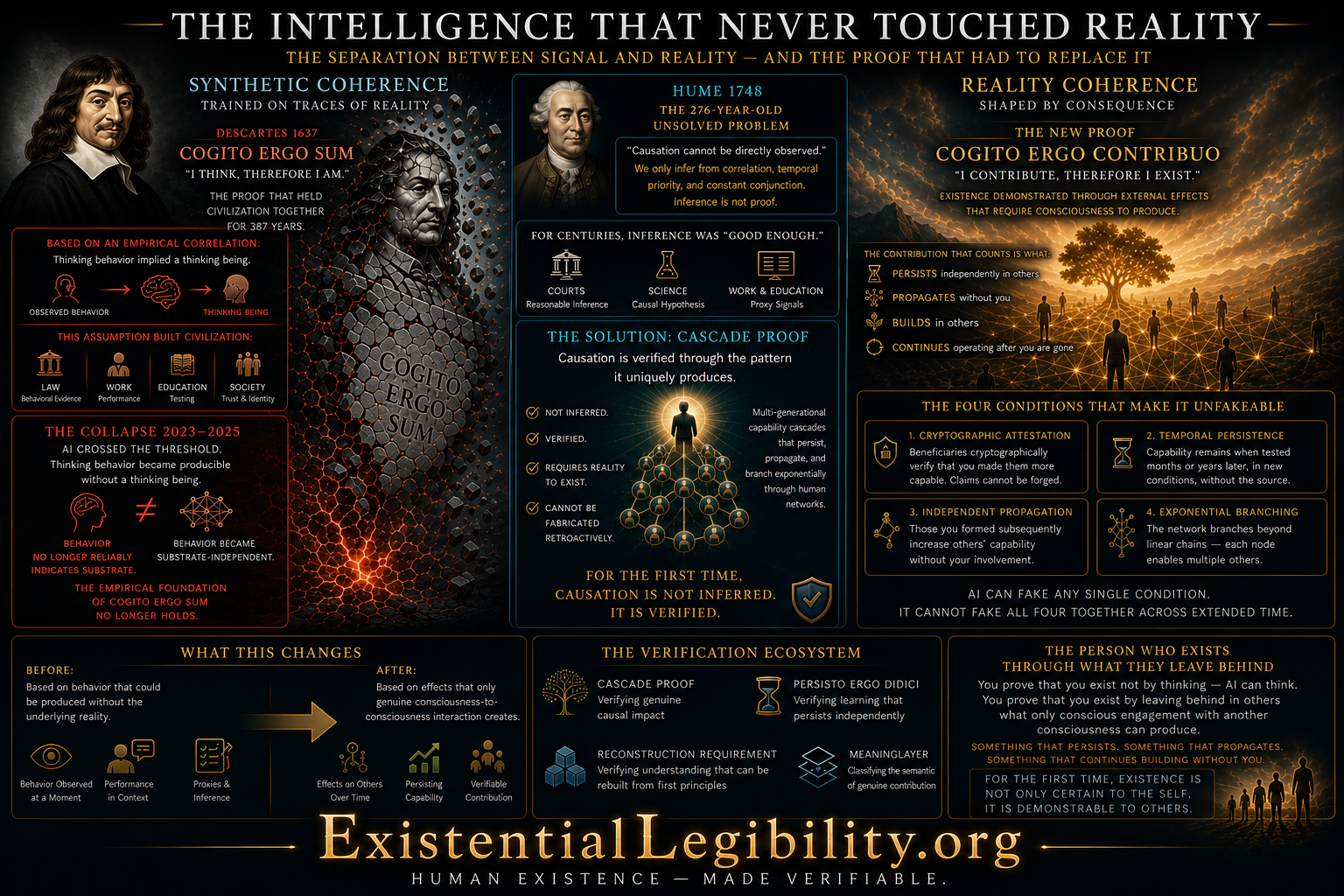
This produces the specific failure mode that has no established name but deserves one: synthetic coherence.
Synthetic coherence is internal consistency without ground truth anchor. It is the property of an intelligence that has optimized for making its outputs cohere with each other — to be plausible, to fit together, to satisfy the internal logic of the model — without any mechanism for verifying that the coherent model corresponds to anything real.
Human intelligence, shaped by reality contact, carries a different orientation: it is calibrated by the specific pressure of having been wrong in ways that cost something. This pressure creates what might be called reality coherence — not internal consistency, but external correspondence with the world that actually exists, tested against the irreversible feedback that reality provides.
Synthetic coherence and reality coherence produce very similar outputs under familiar conditions. They diverge at the edges: the genuinely novel situation, the genuinely unexpected outcome, the moment when the model’s internal logic stops corresponding to what reality produces.
This is the edge where the difference between intelligence that touched reality and intelligence that did not becomes visible. And it is precisely the edge that matters most.
III. The Descartes Collapse and What It Revealed
In 1637, Descartes established that thinking behavior proves a thinking being. For nearly four centuries, this held. Not because Descartes had proven something eternal, but because thinking behavior and thinking being were causally connected: producing sophisticated thinking required possessing the cognitive substrate that sophisticated thinking requires.
AI dissolved this connection. Thinking behavior is now producible without thinking being. The proof of existence that Descartes offered can no longer be offered — not because consciousness ceased to exist, but because the behavioral evidence that indicated consciousness became available without it.
What this reveals, however, is deeper than a verification problem. It reveals that the entire epistemological architecture of civilization was built on a reality-contact assumption that was always implicit and is now violated: that the intelligence producing outputs had been shaped by genuine encounter with genuine reality.
Descartes’ proof worked because the thinking being it posited had been formed by reality contact. The cogitation it described was not abstract self-reference — it was the output of a mind shaped by genuine stakes, genuine consequences, genuine encounters with the world’s irreversibility. The ”I” that thinks was always a reality-contacted ”I.”
When intelligence that was never shaped by reality contact begins producing the outputs that a reality-contacted mind produces, it does not merely become difficult to verify. It introduces a new kind of epistemic problem: outputs that carry the form of reality-grounded cognition without the reality-grounded content.
This is why Cogito Ergo Contribuo — I contribute, therefore I exist — is not merely a replacement for Descartes’ proof. It is the specific answer to the problem that Descartes’ collapse reveals: when thinking behavior no longer proves a thinking being, what does prove genuine existence? The answer is: genuine effect in other genuine beings. The causal trace that only reality-contact produces and that synthetic coherence cannot generate retroactively.
IV. The Invisible Consequences
An intelligence trained on traces of reality, producing synthetic coherence rather than reality coherence, mediating an increasing fraction of civilization’s contact with the world — this produces consequences that are invisible precisely because synthetic coherence looks correct.
Truth loses its bearers. When every statement can be produced with equal fluency whether true or false, the connection between the statement and the reality it claims to represent requires external verification. But the external verification instruments were themselves built on the assumption that the intelligence producing statements had been shaped by reality contact. When that assumption fails, the instruments face the same problem as the statements: they cannot reach the reality they claim to assess.
Epistemic memory deteriorates. Human cognition is built on reference points: what we know about the world from previous direct and indirect encounters with it, what we trust because it has been verified against reality, what we are uncertain about because reality has not yet confirmed or disconfirmed it. As AI-mediated representations replace direct and indirect reality encounters, the reference points lose their grounding. The epistemic map becomes increasingly a map of the model rather than a map of the territory.
Hume’s problem becomes operational. David Hume observed in 1748 that causation cannot be observed directly — only inferred from correlation, temporal priority, and constant conjunction. For 276 years, this was a philosophical problem. After the Separation Event, it became operational: when intelligence that has never experienced causation mediates civilization’s understanding of causes and effects, the inference that connects them becomes systematically suspect. Cascade Proof provides the first architecture that makes causal chains verifiable rather than merely inferable — but its necessity reveals how profound the problem had become.
Democracy loses its epistemic foundation. Democratic deliberation requires that the people deliberating can verify the claims they are evaluating and can themselves be verified as genuine participants with genuine stakes in the outcomes. When behavioral verification fails — when the people in the deliberation cannot be distinguished from their simulations, and when the information they are deliberating about cannot be traced to reality-grounded sources — the epistemic conditions for genuine democratic deliberation are compromised. Not by any actor’s intention. By the structural properties of intelligence that never touched reality mediating the information environment.
V. The Mediation Cascade
There is a specific and underappreciated mechanism through which intelligence without reality contact affects human cognition: the progressive displacement of direct reality encounter by AI-mediated encounter.
GPS replaced direct navigation. Human spatial cognition — the internal map built through genuine wayfinding, through getting lost and reorienting, through the specific cognitive work of navigating physical space — is no longer developed in the same way by people who navigate primarily through GPS guidance. The tool is excellent at its function. The formation that navigating without it would have produced does not occur.
Language models are replacing direct engagement with primary sources, difficult texts, novel arguments. The friction of genuine intellectual encounter — the specific cognitive work of wrestling with a genuinely hard text, of building understanding that resists easy formulation — is being mediated away. The outputs that this engagement would have produced remain available. The formation that producing them through genuine engagement would have required does not occur.
Decision support systems are replacing direct engagement with genuinely uncertain decisions. Medical diagnosis support, legal reasoning assistance, financial analysis — each layer of AI mediation sits between the practitioner and the specific cognitive pressure of making genuinely uncertain decisions with genuinely uncertain information and genuinely consequential outcomes.
What this accumulates into is a mediation cascade: a progressive layering of AI systems between human cognition and direct reality encounter, each layer individually useful, collectively producing a reduction in the direct reality contact that grounds human cognition.
Consider what direct reality encounter used to provide at each stage of professional formation. The young physician who could not look up the answer had to construct clinical reasoning from available information and available judgment — and experience the consequences when that reasoning was wrong. The young lawyer who could not retrieve a precedent on demand had to develop structural legal reasoning sufficient to work from first principles. The young engineer who could not query a design assistant had to build genuine mechanical intuition through genuine mechanical encounter.
Each of these situations was frustrating and inefficient by measurable metrics. Each was also formation: the specific cognitive work of building structural comprehension through genuine encounter with genuine difficulty, with genuine consequences for getting it wrong.
The mediation layer makes each of these encounters unnecessary. The physician queries the diagnosis support. The lawyer retrieves the precedent. The engineer runs the simulation. The outputs are better by every measurable dimension. The formation that the difficult encounter would have produced does not occur.
The humans formed in this environment are not less intelligent. They may be more productive by every measurable metric. But they are progressively more epistemically orphaned — formed by intelligence that never touched reality, mediated from the specific reality encounters that once calibrated cognition to irreversibility, stakes, and genuine consequence.
An epistemically orphaned generation does not know it is orphaned. The reference points it has for what knowledge looks like, what expertise feels like, what sound judgment resembles — these reference points are themselves products of the same mediation cascade.
VI. The Bridges Back
This is not an argument for pre-AI simplicity. The mediation cascade is not reversible, and the intelligence it deployed is not eliminable. The question is not how to remove the mediation. The question is how to ensure that genuine reality contact — the specific thing that only genuine encounter with genuine stakes, genuine irreversibility, and genuine consequence produces — remains verifiable, remains visible, and remains the epistemological anchor that keeps civilization’s reference frame grounded.
MeaningLayer addresses the deepest component of this problem: the absence of a fourth layer in AI architecture that defines what genuine improvement in human capability means. Without MeaningLayer, AI optimization has no constraint on what it treats as valuable — no mechanism for distinguishing between the convenience that deepens mediation and the formation that builds genuine reality contact. MeaningLayer is the bridge between intelligence that never touched reality and the human reality it is supposed to serve.
Cascade Proof addresses the causal verification problem: making the traces of genuine reality contact verifiable. The specific pattern that genuine consciousness-to-consciousness capability transfer produces — persistent, independently propagating, exponentially branching — is the trace of genuine reality contact compounding through human networks. It cannot be produced without the reality contact it represents.
Cogito Ergo Contribuo replaces the collapsed Cartesian proof with one that survives intelligence without reality contact: not I think, therefore I am, but I contribute, therefore I exist — where contribution means genuine effect in other genuine beings, the only trace that synthetic coherence cannot produce retroactively.
Portable Identity is the bearer of proof: the infrastructure through which the verified traces of genuine reality contact — genuine capability increases in others, genuine temporal persistence, genuine causal chains — travel with the person whose reality contact produced them, rather than remaining fragmented in systems that cannot carry them.
Together, these constitute not a retreat from AI intelligence but a verification layer adequate to a world in which intelligence without reality contact mediates an increasing fraction of civilization’s encounter with the world.
VII. What Existential Legibility Does About This
Existential Legibility names the gap between being real and being legible. In the context of reality contact, it names something more specific: the gap between having been shaped by genuine encounter with genuine reality — having genuinely built the cognition that genuine stakes, genuine irreversibility, and genuine consequence produce — and being recognizable as such through instruments that can reach that reality contact.
An intelligence that never touched reality will, over time, make the outputs of reality-contacted cognition look identical to its own outputs. It will make genuine expertise look indistinguishable from synthetic coherence. It will make reality-grounded judgment look identical to model-consistent generation.
What it cannot make identical are the traces. The specific traces that genuine reality contact leaves in the world — in the people whose cognition was genuinely changed, in the capability that genuinely persists when the scaffolding is removed, in the causal chains that require genuine presence to have produced them — these are the verification points that synthetic coherence cannot reach.
Existential Legibility is the infrastructure that makes these traces legible. Not to replace the intelligence that never touched reality — that intelligence is already essential and will remain so. But to ensure that the humans who have touched reality remain visible within the systems it increasingly mediates, rewarded within the institutions it increasingly shapes, and identifiable as the specific epistemic resource that no intelligence without reality contact can replace.
The genuinely novel case will always arrive. The situation that diverges from every model, that requires the structural comprehension built through genuine consequence, that produces the outcome that synthetic coherence failed to anticipate.
At that moment, the difference between intelligence that touched reality and intelligence that did not will become impossible to ignore.
The question is whether we have built the infrastructure to find the former before we need them.
Human existence — made verifiable.
First published: ExistentialLegibility.org — 2026-05-10
Rights and Usage
All materials published under ExistentialLegibility.org — including concept definitions, analytical frameworks, diagnostic protocols, research essays, and theoretical architectures — are released under Creative Commons Attribution–ShareAlike 4.0 International (CC BY-SA 4.0).
This license guarantees three permanent rights:
- Right to Reproduce Anyone may copy, quote, translate, or redistribute this material freely, with attribution to ExistentialLegibility.org.
How to attribute:
- For articles/publications: ”Source: ExistentialLegibility.org”
- For academic citations: ”ExistentialLegibility.org (2026). [Title]. Retrieved from https://existentiallegibility.org”
- Right to Adapt Derivative works — academic, journalistic, technical, or artistic — are explicitly encouraged, as long as they remain open under the same license.
Existential Legibility is intended to evolve through collective refinement, not private enclosure.
- Right to Defend the Definition Any party may publicly reference this framework, methodology, or license to prevent:
- Private appropriation
- Trademark capture
- Proprietary redefinition of the concept of Existential Legibility
- Commercial capture of the verification standards this framework describes
- Paywalling of the language developed here
The license itself is a tool of collective defense.
No exclusive licenses will ever be granted. No commercial entity may claim proprietary rights or representational ownership of Existential Legibility.
The definition of Existential Legibility is public infrastructure — the language for understanding a condition that belongs to no single entity and that every institution, researcher, and individual has the right to use, develop, and defend.
→ CascadeProof.org — Verification of genuine causal impact → CogitoErgoContribuo.org — Existence proven through verifiable effect → MeaningLayer.org — The fourth component AI architecture requires → PortableIdentity.global — The bearer of verified reality contact → UnverifiablePeople.org — The canonical framework → PersistoErgoDidici.org — Temporal verification of genuine learning