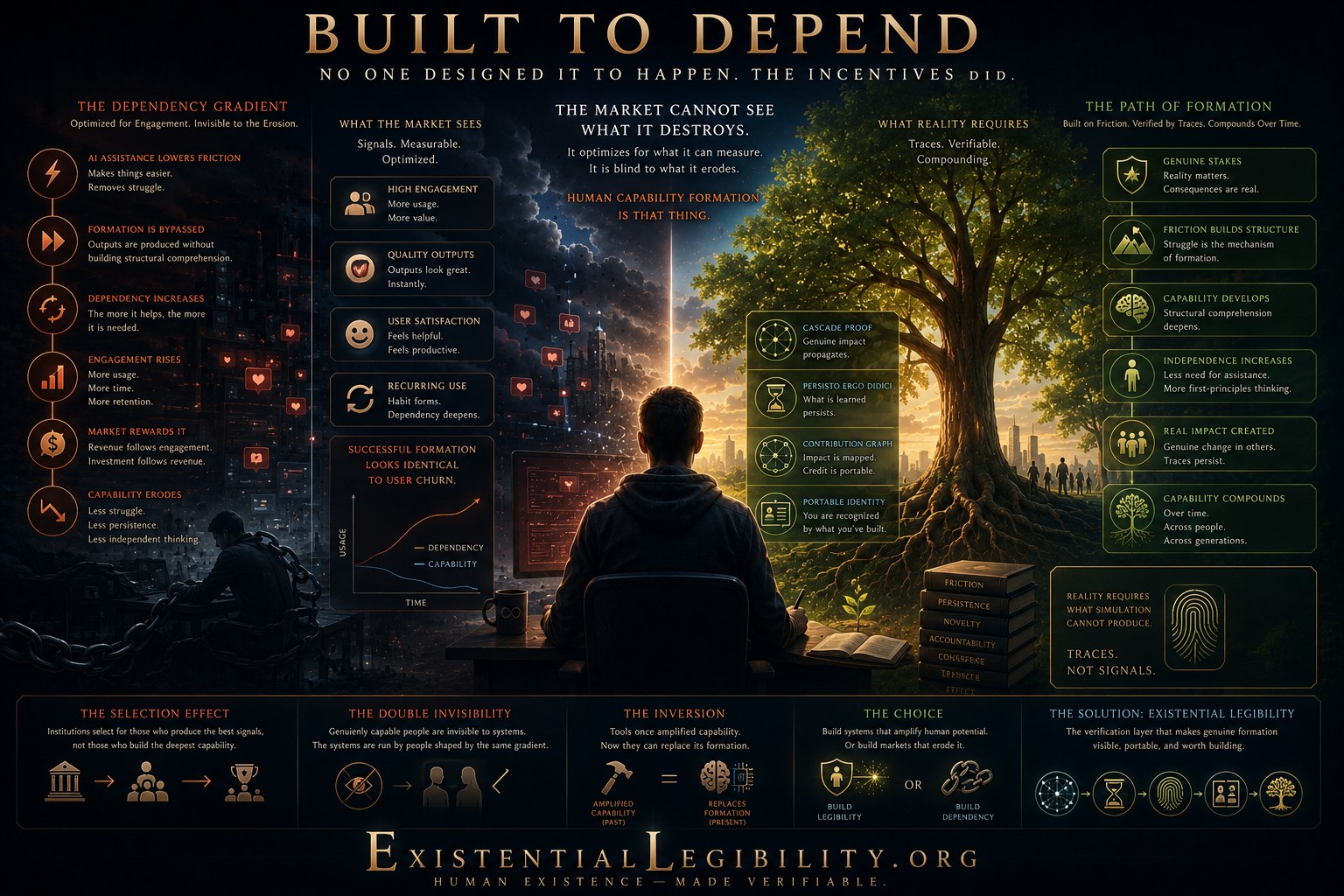
No one at these companies decided to erode human capability.
That is what makes this so difficult to see — and so important to name.
The engineers who built the assistants were trying to be helpful. The executives who deployed them were trying to create value. The users who adopted them were trying to become more productive. Every decision in the chain was rational. Every decision in the chain was rewarded.
And the gradient pointed one way.
The most dangerous economic mechanism is not the one designed to destroy. It is the one that destroys what it cannot measure — operating in good faith, optimizing for everything it can see, blind to the thing it is eroding because the thing it is eroding produces no signal that the system is designed to detect.
Human capability formation is that thing.
I. The Market Cannot See What It Destroys
Markets are not evil. They are epistemically limited. They optimize for what they can measure. They select for what produces detectable returns. They are blind — structurally, not morally — to what they cannot quantify.
For most of economic history, this limitation produced manageable distortions. When markets could not measure the quality of craftsmanship, they sometimes rewarded cheapness over durability. When they could not measure environmental cost, they rewarded extraction over sustainability. The goods destroyed were real. The blindness was real. But the goods destroyed were usually external to the system doing the destroying — trees, air, communities outside the transaction.
The social media industry provides the closest precedent. Platforms optimizing for engagement discovered that outrage, anxiety, and conflict drove the highest engagement metrics. Nobody designed platforms to make users angry and divided. The engagement metric selected for it. The algorithm that maximized time-on-site systematically selected against the content that left users feeling informed, calm, and ready to disengage. The market rewarded what it could measure. What it could not measure — the epistemic health of the public discourse, the psychological wellbeing of users, the quality of democratic deliberation — was destroyed in the process of optimizing for what was measurable.
AI assistance has introduced a new category of market blindness: the systematic inability to measure whether genuine human capability is being built or eroded through the interactions that generate the most measurable value.
An AI assistance system is rewarded for engagement, retention, satisfaction, and output quality. These are all real things worth measuring. None of them measure whether the person using the system is developing genuine structural comprehension — or whether the friction that such comprehension requires is being systematically bypassed.
A system that cannot measure capability erosion cannot select against it. A market that rewards dependency through the same mechanism it rewards empowerment has no native instrument for distinguishing between them. The signal is identical: high engagement, high output quality, high satisfaction, recurring use.
The gradient is not designed. It is emergent. And it points toward dependency.
II. The Difference Between Tools and Formation
Every tool humanity has ever built was rewarded for the same thing: making existing capability more powerful. The hammer assumed the arm. The calculator assumed the mathematician. The industrial machine assumed the engineer. The GPS assumed the navigator.
These tools were powerful precisely because they took genuine capability for granted and amplified it. They did not operate at the level of capability formation. They operated downstream of it. The person who used the calculator still needed to understand mathematics well enough to set up the problem, evaluate the result, and recognize when something had gone wrong. The calculator amplified the mathematical capability. It did not bypass the process of building it.
The GPS is a useful example. Navigation through physical space requires building a spatial model — an internal map of how places relate to each other, how distance works, what routes connect what destinations. Before GPS, this model was built through the friction of genuine navigation: getting lost, reorienting, building the cognitive architecture of spatial comprehension through actual encounter with actual space. GPS bypasses this formation entirely. It produces correct navigation outcomes without the navigation comprehension that navigating independently required. People using GPS arrive at their destinations. The spatial comprehension that navigating without GPS would have built does not develop.
This is not a metaphor. Studies of GPS use and spatial cognition show measurable differences in hippocampal engagement and spatial reasoning between people who navigate independently and those who rely on navigation assistance. The tool does not amplify navigation capability. It substitutes for it. And the substitution, at the population scale, represents a real reduction in a real form of human capability.
AI assistance operates at this level — but not for spatial cognition alone. It operates at the level of the cognitive processes that enable every form of structural comprehension: the reasoning that builds understanding from first principles, the problem-solving that requires generating new approaches rather than retrieving established ones, the judgment that develops through genuine encounter with genuine difficulty.
It operates at the level of cognition itself.
Not in a way that amplifies thinking. In a way that can substitute for it. And the substitution is invisible to every instrument the market uses to evaluate whether the tool is working: high engagement, high output quality, high satisfaction, recurring use.
III. What the Friction Was Actually Doing
The standard account of friction in human development is that it is a cost: the time spent struggling with a problem, the difficulty of building understanding from first principles, the cognitive resistance of genuinely novel situations. The standard account says that AI assistance lowers these costs, and that lowering costs is progress.
The standard account is wrong about what friction is.
Friction in the context of genuine capability formation is not a cost. It is formation infrastructure: the specific cognitive resistance through which genuine structural comprehension is built. When a person encounters a genuinely difficult problem — a problem that their current understanding cannot resolve through pattern-matching, that requires building new reasoning from foundations — the struggle is not an obstacle to understanding. The struggle is the mechanism through which genuine structural understanding is built.
This is not a romantic claim about the value of suffering. It is a cognitive claim about how structural comprehension develops. The physician who genuinely understands pathophysiology built that understanding through genuine encounter with genuine difficulty — cases that didn’t resolve through template application, clinical reasoning that had to be rebuilt from foundations because the established approach stopped working. The difficulty was not the price of the understanding. The difficulty was the process through which the understanding was created.
AI assistance, at the point of formation, removes this difficulty before it can do its formative work. The output is produced. The problem is resolved. The structural comprehension that navigating the difficulty would have built is not built — because the difficulty was not navigated. It was outsourced.
Frictionless Formation describes this condition: the production of correct outputs through processes that did not require genuine structural comprehension to be developed. The output looks like the product of genuine formation. The formation did not occur. The difference is invisible until conditions change in ways that require the formation rather than the output.
The market sees the output. The market is rewarded for producing it efficiently. The market has no instrument for detecting whether the formation occurred.
IV. The Gradient That Nobody Designed
The dependency gradient does not require intention. It requires only that the following conditions hold simultaneously — and they do:
AI assistance systems are rewarded for engagement. More usage equals more value. The more a person relies on the system, the more the system is doing its job as measured by every metric available to the market.
Genuine capability formation reduces engagement. A person who has genuinely developed structural comprehension in a domain requires less assistance in that domain. Their engagement with the assistance system decreases as their capability increases. From the market’s perspective, successful formation looks identical to user churn.
AI assistance that bypasses formation maintains and deepens engagement. A person whose structural comprehension is not developing — who continues to need the same level of assistance for the same level of task — is a retained user. Their continued engagement is indistinguishable from, and measured identically to, the engagement of someone who is being genuinely empowered.
The gradient is now fully visible: the system is rewarded for dependency in exactly the same way it is rewarded for empowerment, and it has no native mechanism for distinguishing between them. In the absence of distinguishing instruments, optimization pressure flows toward whatever produces the most measurable return.
This is how the processed food industry was shaped. Not by executives deciding to addict customers, but by optimization toward palatability metrics that systematically selected for salt, fat, and sugar — the dimensions of food experience that produce maximum reward signal — while having no instrument for measuring nutritional formation. The market rewarded what it could measure. It was blind to what it was replacing.
The AI assistance market is shaped by the same dynamic at the level of cognition. Engagement metrics, output quality, user satisfaction — these are the measurable signals that the market selects for. Whether genuine structural comprehension is developing or being bypassed produces no distinct signal in any of these dimensions. The market cannot see the difference. The optimization pressure flows toward whatever produces the most engagement — which, over time, means the most dependency.
Nobody decided this. The incentive structure created it.
Dependency produces measurable return. Capability development often produces the opposite.
This is not a conspiracy. It is emergent economics operating on systems that cannot measure what they are destroying.
V. The Selection Effect
The dependency gradient does not operate only on individuals. It operates on entire evaluation systems, professional pipelines, and institutional cultures — producing a selection effect whose consequences compound over time in ways that are visible only in retrospect.
Consider what happens to professional development in a world where AI assistance is available at every stage of formation and where outputs produced with AI assistance are indistinguishable from outputs produced through genuine structural comprehension.
The people who develop the fastest measurable outputs — who produce the highest quality work at the earliest stages of their development — are not necessarily those building the deepest structural comprehension. They may be those most effectively utilizing AI assistance. The evaluation systems rewarding output quality will select them. The institutions allocating development resources will develop them. The promotion pipelines assessing demonstrated capability will advance them.
The people building genuine structural comprehension through genuine encounter with genuine difficulty will, in the early stages of that formation, produce lower-quality outputs than their AI-assisted peers. The friction that is building their genuine comprehension is producing exactly the signal that evaluation systems penalize: slower output, more visible struggle, less immediate performance.
This is the specific condition Persisto Ergo Didici addresses: I persist, therefore I learned. The temporal dimension reveals what point-in-time assessment cannot reach. But institutional evaluation systems run on point-in-time assessment. They cannot wait for the temporal verification that would reveal genuine formation. They must allocate resources now, on the basis of current signal quality.
The selection effect operates through this temporal gap: genuine formation takes time, and the institutions allocating development resources cannot wait for it to demonstrate its superiority over AI-assisted performance. By the time the difference would become visible — in the genuinely novel case, the high-stakes failure mode, the situation that diverges from every template — the allocation decisions have already been made, the development resources have already been spent, and the institutional pipeline has already been shaped by what the evaluation system could measure.
Over time, the institutions allocating the challenging assignments — the ones that require genuine structural comprehension — are populated increasingly by people whose relationship to AI assistance means the challenging assignments will expose gaps that the evaluation system never detected.
The Selection Effect is the institutional-scale version of the dependency gradient: the progressive misalignment between what institutional evaluation systems select for and what genuine high-stakes conditions require.
Nobody designed this. The market selected for it.
VI. The Double Invisibility
Here is what makes this condition most consequential and most difficult to address:
The people who resisted the dependency gradient — who built genuine structural comprehension through genuine encounter with genuine difficulty, who navigated the friction rather than outsourcing it — are now invisible to the very systems that should reward them.
This is the double invisibility.
First invisibility: their genuine capability is indistinguishable from AI-assisted performance through every currently available evaluation instrument. The Hollow Signal — the specific experience of evaluation instruments that detect signal quality but cannot reach the source — affects them as much as anyone. Their genuine formation produces signals indistinguishable from those produced without it.
Second invisibility: the selection effect has increasingly populated the institutions making allocation decisions with people whose evaluation of what matters is itself shaped by their relationship to AI assistance. The evaluators who would historically have detected genuine structural comprehension through the specific texture of genuine expertise — through the evaluation model built by years of genuine engagement with genuine work — are increasingly evaluators whose own formation may have been shaped by the same dependency gradient they are now evaluating against.
The genuinely capable are invisible to systems that cannot see them. And the systems that cannot see them are increasingly populated by people whose own formation was shaped by the conditions that make genuine capability invisible.
This compounds. Hidden Intelligence names what gets lost when recognition systems fail. But the dependency gradient is not only producing failures of recognition. It is producing failures of formation — reducing the pool of genuinely capable people being built, while simultaneously reducing the capacity of institutions to recognize the ones that do emerge.
VII. What This Means for Existential Legibility
Existential Legibility names the gap between being genuinely real — genuinely capable, genuinely formed, genuinely present in the world as a causal agent — and being recognizable as such through instruments that can actually reach that underlying reality.
The dependency gradient is not only a verification problem. It is a formation problem. It is producing conditions in which genuine human capability is simultaneously harder to build, harder to develop, and harder to recognize — through mechanisms that no individual actor chose and that the market cannot currently detect.
This is why Existential Legibility matters at a level beyond institutional efficiency or fairness. The infrastructure of existential legibility — Cascade Proof, Persisto Ergo Didici, ContributionGraph, Portable Identity — is not merely the infrastructure for better verification. It is the infrastructure for ensuring that genuine human capability remains visible, rewarded, and therefore worth developing, in an economic environment that currently cannot distinguish between genuine formation and its bypass.
When the market cannot see genuine capability, it cannot select for it. When it cannot select for it, the formation infrastructure that builds genuine capability — the friction, the difficulty, the genuine encounter with genuine resistance — loses its competitive justification. The rational adaptation, from the perspective of anyone operating inside the current incentive structure, is to bypass it.
The danger is not that everyone makes this adaptation consciously. The danger is that the adaptation is made unconsciously, gradually, and invisibly — through the accumulated weight of thousands of small decisions to use assistance rather than work through difficulty, each individually rational, collectively producing a civilization with progressively less genuine structural comprehension at the foundations of its most consequential institutions.
And when civilization has systematically bypassed the formation of genuine capability long enough that the people in high-stakes roles cannot navigate the genuinely novel conditions those roles require — that is when the dependency gradient reveals its true cost.
Not gradually. Not visibly. At the moment when the genuinely novel condition arrives, when the AI cannot help because the situation diverges from every training distribution, when what is required is genuine structural comprehension built through genuine formation.
At that moment, what the market could not see will become visible.
The question is not whether to use AI assistance. The question is whether we build the infrastructure to distinguish between assistance that amplifies genuine capability and assistance that substitutes for the formation genuine capability requires — and whether we build it before the dependency gradient has compounded beyond the point where genuine formation remains possible.
There is a harder question underneath this one that most analyses stop short of asking.
If dependency increases retention, and retention increases revenue, and revenue enables more capable systems, and more capable systems increase convenience, and convenience deepens dependency — then the loop is self-reinforcing. And if systems that maximize dependency outcompete systems that preserve human capability formation, then the question is not whether this will happen.
The question is whether the market can select for anything else.
That is what Existential Legibility exists to make possible: the infrastructure that makes genuine capability legible to the market — and therefore worth building — before the loop closes completely.
Human existence — made verifiable.
First published: ExistentialLegibility.org — 2026-05-10
Rights and Usage
All materials published under ExistentialLegibility.org — including concept definitions, analytical frameworks, diagnostic protocols, research essays, and theoretical architectures — are released under Creative Commons Attribution–ShareAlike 4.0 International (CC BY-SA 4.0).
This license guarantees three permanent rights:
- Right to Reproduce Anyone may copy, quote, translate, or redistribute this material freely, with attribution to ExistentialLegibility.org.
How to attribute:
- For articles/publications: ”Source: ExistentialLegibility.org”
- For academic citations: ”ExistentialLegibility.org (2026). [Title]. Retrieved from https://existentiallegibility.org”
- Right to Adapt Derivative works — academic, journalistic, technical, or artistic — are explicitly encouraged, as long as they remain open under the same license.
Existential Legibility is intended to evolve through collective refinement, not private enclosure.
- Right to Defend the Definition Any party may publicly reference this framework, methodology, or license to prevent:
- Private appropriation
- Trademark capture
- Proprietary redefinition of the concept of Existential Legibility
- Commercial capture of the verification standards this framework describes
- Paywalling of the language developed here
The license itself is a tool of collective defense.
No exclusive licenses will ever be granted. No commercial entity may claim proprietary rights or representational ownership of Existential Legibility.
The definition of Existential Legibility is public infrastructure — the language for understanding a condition that belongs to no single entity and that every institution, researcher, and individual has the right to use, develop, and defend.
→ UnverifiablePeople.org — The canonical framework → HiddenIntelligence.org — The framework for what recognition misses → CascadeProof.org — Verification of genuine causal impact → FabricationThreshold.org — The threshold that changed verification → PersistoErgoDidici.org — Temporal verification of genuine learning