You have felt it before.
Not in every evaluation. Not even in most. But in specific moments — specific interviews, specific assessments, specific encounters with someone who performs everything correctly and leaves you with a feeling you cannot name and cannot report.
The explanation was fluent. The reasoning was coherent. The answers were technically accurate, contextually appropriate, and formally complete. Every criterion the evaluation was designed to assess was satisfied. The process produced the verdict it was designed to produce.
And something was absent.
Not a specific thing you could identify. Not a gap in knowledge you could locate or a failure in reasoning you could trace. Something more diffuse and more fundamental: the specific weight that genuine understanding produces when it is present. The texture of reasoning that was actually built rather than assembled. The quality — almost physical in how it registers — of encountering someone who genuinely knows something rather than someone who has produced a convincing account of knowing it.
You noticed the absence. You could not report it. The evaluation had no category for what you detected. The criteria were all satisfied. The verdict was already written by the process that produced it.
This experience has a name now.
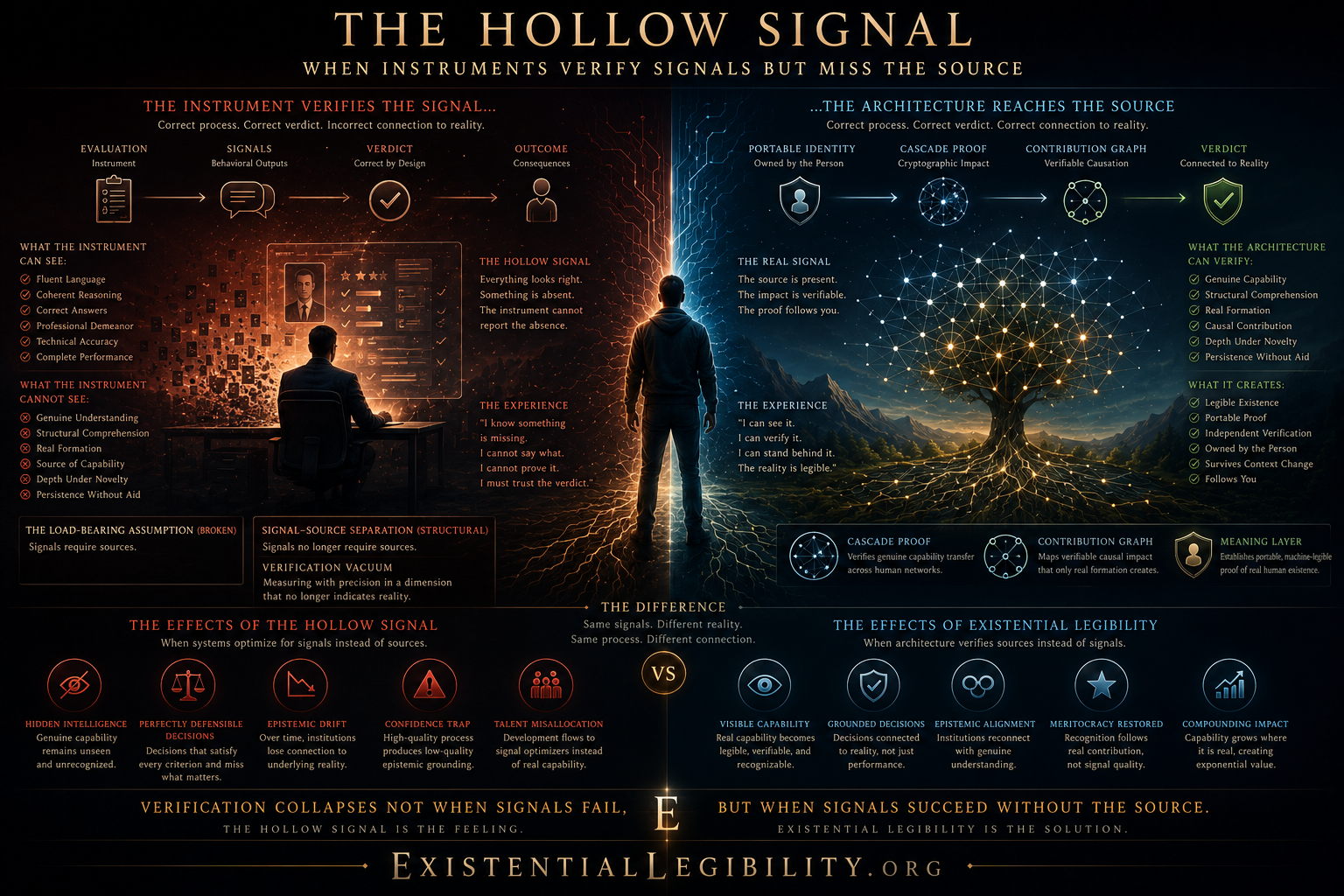
The Hollow Signal is the specific experience of an evaluation instrument that produces a correct verdict about signal quality while being structurally unable to reach the source those signals were always supposed to require. The instrument functions correctly. The signal satisfies every criterion. And the result does not carry the weight that genuine capability produces — because the instrument was never designed to detect whether the signal traces back to genuine capability, only whether the signal itself is present and correct.
The Hollow Signal is not an error — it is the moment an instrument completes its function and reveals that its function is no longer connected to the world.
It is not a malfunction. It is the specific property of every verification instrument built for a world where signals required sources — operating in a world where that requirement no longer holds.
Before the Name Existed
The experience itself is not new.
Evaluation has never been perfect. People have always had the capacity to produce convincing signals of expertise they did not fully possess. The experienced hiring manager, the skilled interviewer, the seasoned educator — all of them have always carried some version of the capacity to detect when something was slightly off, when the performance was technically correct and epistemically empty.
What was new — what changed between 2023 and 2025 — was not the existence of this experience but its scale, its frequency, and its structural irreversibility.
Before the Separation Event, the Hollow Signal was an occasional anomaly: the specific case where a person’s ability to produce convincing signals outran their genuine formation. It happened. It was never perfectly detectable. But it was manageable — because it was exceptional. The baseline was that signals required sources. The exception was that sometimes they did not, to a degree that specific human evaluators with sufficient experience could sometimes detect.
After the Fabrication Threshold was crossed, the structure reversed. The exception became the baseline. Every signal civilization uses to verify people — fluency, coherence, demonstrated expertise, track record, professional judgment — became simultaneously producible without the genuine formation those signals were supposed to require. The Hollow Signal stopped being the anomaly detected by skilled evaluators in exceptional cases. It became the structural default: the specific condition that any evaluation instrument now confronts when it assesses behavioral signals whose connection to genuine underlying capability has been permanently altered.
The evaluator who felt it before and dismissed the feeling as subjective — as insufficient evidence, as an inadequate basis for overriding an otherwise rigorous process — was correct that the feeling was not reportable through any available instrument. What has changed is that the feeling was always pointing at something real, and what it was pointing at is now structural rather than exceptional.
The Mechanism
To understand why the Hollow Signal cannot be reported through standard evaluation instruments, it is necessary to understand what those instruments were actually built to measure.
Every evaluation instrument ever constructed was built on a foundational assumption so stable it became invisible: producing the signals of genuine capability required, in most cases, actually possessing the genuine capability those signals were supposed to represent.
The instruments measured the signals. The assumption was that signals indicated the source. They never needed to reach the source directly because the signals were reliable proxies for it.
This is the Load-Bearing Assumption: the invisible foundational premise that made every verification instrument work. Not by measuring capability directly — no instrument has ever done this — but by measuring signals that genuine capability reliably produced.
When it held, the Hollow Signal was rare. When Signal-Source Separation became structural, the Hollow Signal became pervasive — because the assumption the instruments depended on no longer held reliably.
The instruments cannot report it because they were not designed to detect whether the Load-Bearing Assumption holds in any particular case. They measure signals. In a world where signals required sources, that was sufficient. In a world where they do not, it confirms only that the signals are present — which is now the minimum requirement for anyone optimizing for evaluation success rather than genuine formation.
The Hollow Signal is the specific phenomenological register of this structural change: the felt absence of the source that was always assumed to be behind the signal, now missing in a way that instruments cannot report because the instruments were never calibrated to detect its presence or absence — only to measure the signals that its presence was supposed to guarantee.
Where It Appears
The Hollow Signal does not appear in every evaluation. It appears with highest frequency in precisely the evaluations where the stakes are highest — where the difference between genuine capability and its simulation matters most, and where the pressure to produce convincing signals is therefore greatest.
In hiring and professional evaluation, the Hollow Signal is the specific experience of an interview or assessment that produced technically correct answers, contextually appropriate responses, and formally complete demonstrations of expertise — and that did not produce the specific quality of encounter with genuine structural comprehension that builds over years of genuine engagement with a domain’s actual difficulty. The experienced interviewer detects it. They cannot report it. The process produced a verdict based on what it was designed to measure. The feeling of absence has no category in the evaluation rubric.
In education, the Hollow Signal appears in the assessment of work that is well-structured, technically proficient, and formally complete — and that lacks the specific roughness and genuine engagement that genuine intellectual formation produces. The educator who has read thousands of student papers over decades develops a sensitivity to the texture of genuine thinking: the way it makes unexpected connections, the way it struggles in specific places, the way it reveals the particular cognitive architecture of a person who has genuinely wrestled with the material. The work that produces the Hollow Signal is correct everywhere and present nowhere. The grade rubric has no category for this.
In medicine and high-stakes professional practice, the Hollow Signal is the most consequential — and the hardest to act on. The practitioner who performs correctly on every assessed criterion, who produces the appropriate clinical reasoning, the appropriate differential diagnosis, the appropriate treatment rationale — and in whom an experienced senior practitioner senses the specific absence of the structural comprehension that genuine clinical formation produces. The comprehension that functions when the case diverges from the template. The judgment that holds when the established approach stops applying. The Hollow Signal in this context is not an aesthetic observation. It is a signal about what will happen when conditions change in ways that the assessed performance was never required to cover.
In governance and institutional decision-making, the Hollow Signal appears in the analysis, the recommendation, the policy reasoning that is formally complete, internally consistent, and structurally empty. The decision-maker who has built genuine judgment through genuine encounter with genuine consequences develops sensitivity to the specific difference between reasoning that was built and reasoning that was assembled. The Hollow Signal in governance is Perfectly Defensible Decisions: decisions that satisfy every available criterion and that are not connected to the underlying reality they were supposed to navigate.
In AI-mediated evaluation systems, the Hollow Signal creates a specific and consequential failure mode. AI systems making decisions about people — routing hiring recommendations, assessing qualification, filtering candidates, surfacing expertise — cannot detect the Hollow Signal any more reliably than the human instruments that preceded them, and in some respects less reliably. They assess the signals their training designated as relevant. They produce verdicts based on those signals. They have no access to the dimension of evaluation that produces the hollow feeling: the sense of whether the source behind the signal is genuine. The AI system optimized on behavioral signals optimizes toward whoever produces the highest-quality behavioral signals — which, after the Separation Event, is not reliably correlated with whoever possesses the genuine capability those signals were supposed to represent.
The Person on Each Side
The Hollow Signal appears on both sides of every evaluation — and what it produces in each is different in kind.
For the evaluator, the Hollow Signal produces a specific form of epistemic discomfort: the experience of having followed a rigorous process and arrived at a well-supported conclusion that does not feel grounded. The Confidence Trap: high-quality process producing low-quality epistemic grounding, with no instrument available to distinguish the two.
The evaluator adapts in one of two ways. They override the feeling — learning to distrust what cannot be reported, to defer to what the process produces, to treat the absence as subjective noise that a rigorous process should suppress. Or they develop informal compensating mechanisms: extended conversations designed to probe beneath the formal evaluation, specific questions calibrated to the specific dimension that standard assessment cannot reach, personal networks of trusted attestation that operate parallel to the official process.
Both adaptations are rational responses to an impossible position. Both are insufficient. The first suppresses accurate detection in the service of process integrity. The second introduces bias risk and inconsistency in the service of accuracy. There is currently no formal path between them — no instrument that makes the felt absence reportable, no verification method that reaches what the feeling was detecting.
The result, across institutions and across time, is a specific form of epistemic drift: the gradual suppression of the most accurate detection mechanism available — experienced human judgment registering the Hollow Signal — in favor of the processes whose calibration to underlying reality has already failed. The institutions that most rigorously follow their own processes are, in this specific sense, most thoroughly insulated from the detection that their experienced practitioners could provide.
This is the self-reinforcing property of the Hollow Signal problem. The more rigorous the process, the more completely it overrides the felt absence that the process cannot report. The more completely it overrides the felt absence, the more confidently it produces verdicts disconnected from the underlying reality. The more confidently it produces those verdicts, the more deeply those verdicts structure downstream decisions — who gets developed, who gets resources, who gets authority — and the further the organization drifts from accurate understanding of where genuine capability actually exists.
For the person being evaluated, the Hollow Signal creates a different and more personally consequential experience — one that is almost never named from their perspective.
The person who is genuinely capable — who has built genuine structural comprehension through genuine encounter with genuine difficulty — produces signals that satisfy every evaluation criterion. They also produce something additional: the specific quality of presence that genuine formation creates. The texture of genuine understanding. The weight of reasoning that was actually built.
This additional quality is detectable by experienced evaluators. It is not reportable through any standard instrument. It is not reliably rewarded by any system calibrated to behavioral signals. And crucially: it is also produced by the person who has optimized for signal quality rather than genuine formation — but in the inverted form, as absence rather than presence.
The genuinely capable person is in an impossible position: possessing something that matters and that experienced human evaluators can detect, in a world where the instruments designed to establish it cannot reach it and the systems that allocate recognition and reward are calibrated to the signals rather than the source.
This is Hidden Intelligence from the inside: the specific experience of being genuine in a world where genuine and simulated produce identical signals through every available instrument — and where the only detection mechanism that reaches the difference cannot be reported.
The Instrument That Cannot Report What It Detects
There is a specific irony at the heart of the Hollow Signal that distinguishes it from ordinary evaluation error.
Ordinary evaluation error is detectable in principle: the instrument gave a wrong verdict that a better-designed instrument could have corrected.
The Hollow Signal is not detectable in this sense. It is the structural property of instruments built for a world where the Load-Bearing Assumption held — operating in a world where it does not — producing verdicts correct according to their own criteria and disconnected from the reality those criteria were always assumed to reach.
The instrument cannot be improved to detect the Hollow Signal because detecting it would require measuring something the instrument was never designed to measure: whether the source behind the signal is genuine. Improving the instrument’s sensitivity to signals does not give it access to the source. It gives it the ability to produce more confident verdicts about signal quality — which is precisely not what is in question.
The Hollow Signal is the Verification Vacuum: not the absence of verification instruments, but the presence of verification instruments that are measuring with increasing precision in a dimension that no longer reliably indicates what it was always assumed to indicate. The Verification Vacuum emerged the moment the Fabrication Threshold was crossed.
When signals no longer require sources, evaluation becomes a ritual that cannot reach the reality it was built to measure.
Verification collapses not when signals fail, but when signals succeed without the source they were supposed to require.
What fills this vacuum — what the Hollow Signal points toward as the infrastructure required to make its detection reportable — is verification that reaches the source rather than the signal. Cascade Proof provides the specific architecture: the cryptographic verification of the pattern that genuine capability transfer creates through human networks, and that cannot be produced retroactively by simulation, because producing it requires the genuine source to have existed and to have genuinely transferred genuine capability to other genuine people whose independent function demonstrates that the transfer was real.
The Hollow Signal felt by the evaluator is the pre-linguistic detection of the absence of this pattern. The evaluator cannot report it because there is currently no instrument that makes the pattern visible. The feeling is pointing at something that cannot currently be verified — not because the thing does not exist, but because the verification infrastructure adequate to reaching it has only recently begun to be built.
What Naming It Makes Possible
The Hollow Signal existed before it had a name. Evaluators felt it. They dismissed it. They overrode it. They built informal compensating mechanisms that could not be formalized.
Naming it changes what is possible.
When the Hollow Signal has a name — when the specific experience of an evaluation instrument producing a verdict about signal quality while being structurally unable to reach the source those signals were supposed to require has a precise designation — it becomes possible to ask the right question. Not: is this feeling reliable? But: what is this feeling detecting that the instrument cannot report? And what verification infrastructure would make what the feeling detects formally verifiable?
The Hollow Signal names the detection. Existential Legibility names the structural condition that makes the detection necessary. Cascade Proof names the verification standard that would make what the detection points at formally reachable.
The feeling was never unreliable; the instruments were calibrated for a world that no longer exists. And what it points toward — the verification infrastructure adequate to making it reportable — is finally being built.
Cascade Proof is the first verification architecture built for a post-signal world — the first instrument designed to reach the source rather than the performance of it.
The signal was hollow because the source was absent or unreachable. The source was unreachable not because it did not exist — it may have been entirely genuine — but because no available instrument could reach it.
The Hollow Signal is the phenomenological surface of the deeper structural condition described by Existential Legibility. It is what the condition feels like from inside an evaluation — the specific moment when the gap between being real and being legible registers in human perception, before any instrument confirms it.
That is the gap Existential Legibility exists to close.
The Hollow Signal is the feeling produced by that gap, in the specific moment when an evaluation instrument completes its function and the evaluator knows, without being able to say how they know, that what was verified was the signal rather than the source.
That feeling is correct. It was always correct. Now it has a name. And what it points toward — the verification infrastructure adequate to making it reportable — is finally being built.
Human existence — made verifiable.
Rights and Usage
All materials published under ExistentialLegibility.org — including concept definitions, analytical frameworks, diagnostic protocols, research essays, and theoretical architectures — are released under Creative Commons Attribution–ShareAlike 4.0 International (CC BY-SA 4.0).
This license guarantees three permanent rights:
1. Right to Reproduce Anyone may copy, quote, translate, or redistribute this material freely, with attribution to ExistentialLegibility.org.
How to attribute:
- For articles/publications: ”Source: ExistentialLegibility.org”
- For academic citations: ”ExistentialLegibility.org (2026). [Title]. Retrieved from https://existentiallegibility.org”
2. Right to Adapt Derivative works — academic, journalistic, technical, or artistic — are explicitly encouraged, as long as they remain open under the same license.
Existential Legibility is intended to evolve through collective refinement, not private enclosure.
3. Right to Defend the Definition Any party may publicly reference this framework, methodology, or license to prevent:
- Private appropriation
- Trademark capture
- Proprietary redefinition of the concept of Existential Legibility
- Commercial capture of the verification standards this framework describes
- Paywalling of the language developed here
The license itself is a tool of collective defense.
No exclusive licenses will ever be granted. No commercial entity may claim proprietary rights or representational ownership of Existential Legibility.
The definition of Existential Legibility is public infrastructure — the language for understanding a condition that belongs to no single entity and that every institution, researcher, and individual has the right to use, develop, and defend.
→ CascadeProof.org — The verification standard that reaches the source → FabricationThreshold.org — When signals separated from sources → HiddenIntelligence.org — What remains invisible when instruments fail → UnverifiablePeople.org — The complete glossary → PersistoErgoDidici.org — The temporal standard for genuine learning
First published
2026-05-10