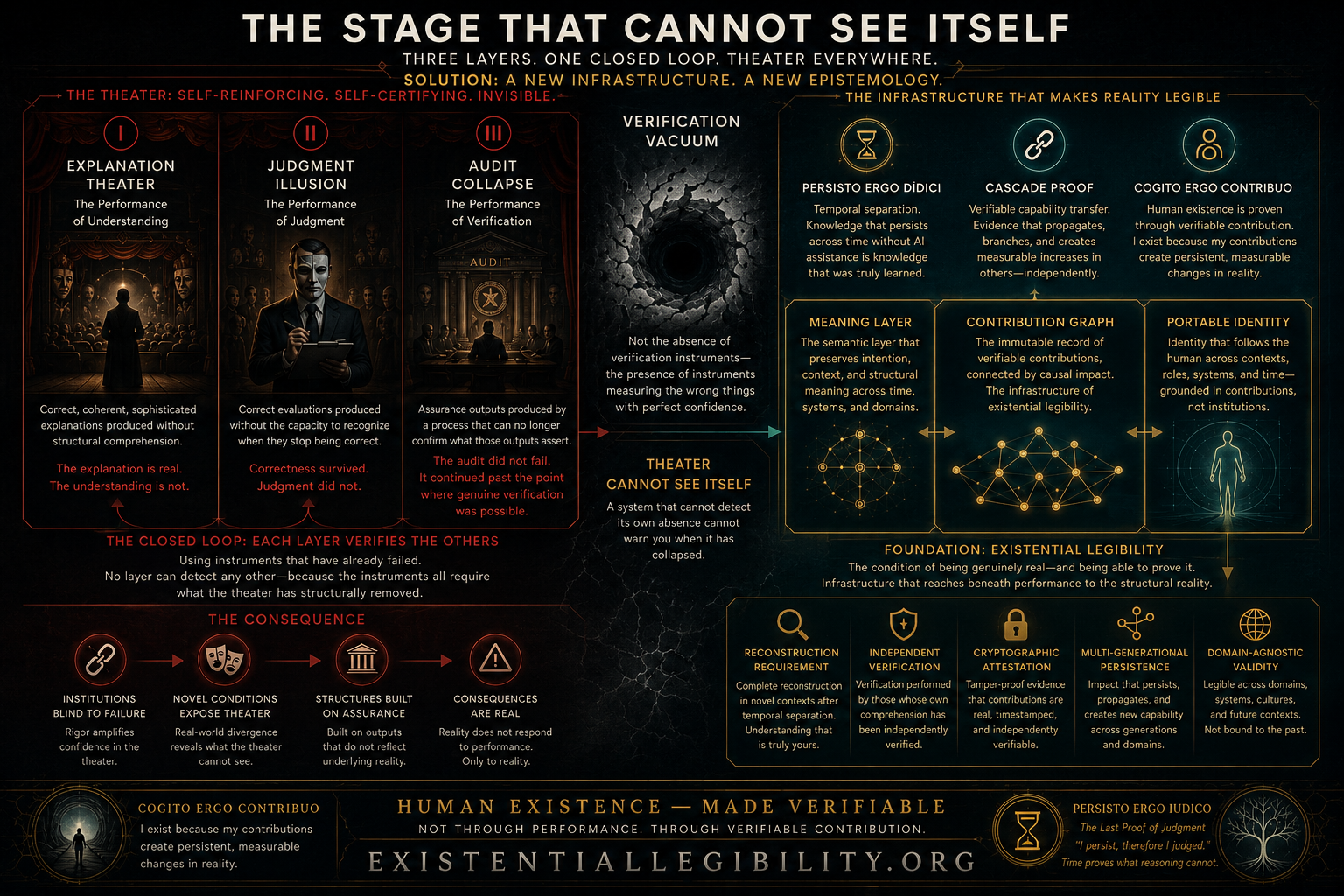
The theater is not a metaphor.
It is a structural condition — operating simultaneously at three layers of every professional institution that depends on genuine expertise, genuine judgment, and genuine verification. Each layer invisible to the others. Each layer verifying the others using the same instruments that have already failed. Each layer producing outputs indistinguishable from the outputs that genuine expertise, genuine judgment, and genuine verification produce.
The performance is real. The understanding is not. The evaluation is real. The judgment is not. The audit is real. The verification is not.
And nothing in the current architecture of any professional institution can detect the difference — because the instruments designed to detect it are performing the same theater they were built to reveal.
This is not a story about deception. No one decided to build a stage instead of a foundation. No one chose performance over substance. The theater emerged structurally — as the predictable consequence of a single foundational change: the separation of behavioral signals from the underlying human reality those signals were always assumed to require.
Three conditions. Three layers. One closed loop.
I. The First Layer: The Performance of Understanding
Explanation Theater is the condition in which correct, coherent, sophisticated explanations are produced without the structural comprehension required to generate them independently. It is not deception. It is a structural property of what AI assistance has made possible: explanation indistinguishable from the explanation that genuine understanding produces — under questioning, under probing, under every contemporaneous assessment instrument civilization has ever used to distinguish comprehension from performance.
The explanation is real. The understanding is not.
This distinction — between the explanation and the understanding beneath it — was invisible before a specific technological threshold was crossed. Producing genuine explanation at expert level required genuine intellectual encounter with a domain’s actual difficulty. You could not articulate why a proof held without having encountered its structure. You could not explain a mechanism without having built some internal model of how it operated. You could not present a clinical argument without having developed, through repeated genuine encounter, some structural model of the domain.
The cognitive work of understanding and the cognitive work of explaining were performed by the same processes. This correlation was so foundational that no one needed to state it. It was the invisible load-bearing structure beneath every examination, every credential, every peer review, every interview civilization ever used to verify expertise.
AI removed this correlation completely. Not by degrading explanation quality — but by making expert-level explanation available without the structural comprehension it once required. Every signal of genuine understanding — coherent reasoning, domain-specific sophistication, appropriate uncertainty, structurally complete explanation — can now be produced without the structural comprehension those signals were supposed to require.
When explanation becomes frictionless, understanding becomes invisible.
The practitioner who produces Explanation Theater does not feel the absence. The cognitive experience of genuine comprehension arrives. The explanations are sophisticated, domain-appropriate, and internally consistent. The structural comprehension that would allow reconstruction, extension, or independent transfer — the comprehension that genuine understanding produces and that genuine challenge would reveal — is not there. But nothing in the moment of production makes that absence detectable.
This is the first layer. It is the cognitive foundation on which the other two rest.
II. The Second Layer: The Performance of Judgment
Judgment Illusion is the extension of Explanation Theater into the evaluative capacity that professional practice requires — the condition where correct evaluations are produced without the evaluative capacity to recognize when they stop being correct.
Correctness survived. Judgment did not.
The distinction is precise and consequential. Explanation Theater concerns the production of understanding’s signals. Judgment Illusion concerns the capacity to evaluate — to assess when established frameworks are still applying, to recognize when a situation has crossed the boundary of the reasoning that was supposed to handle it, to detect the moment when expertise needs to adapt rather than retrieve.
This capacity is not the same as producing correct answers. It is the meta-cognitive architecture — built through genuine encounter with genuine failure, through the specific cognitive formation that only being wrong in ways that cost something produces — that allows a practitioner to know when their established understanding has stopped corresponding to what the situation actually requires.
AI assistance removes the formation of this capacity through exactly the mechanism it removes structural comprehension: by making the signals of sound evaluative judgment producible without the genuine evaluative encounters that build genuine evaluative capacity.
The practitioner whose formation consisted primarily of AI-assisted performance develops cognitive competence in producing evaluations that satisfy quality metrics. What does not develop is the structural model of the domain’s failure modes — the internal map built through genuine encounter with genuine edge cases, genuine unexpected outcomes, genuine situations that diverged from every template.
The consequence is the specific condition Judgment Illusion describes: evaluations that are correct until conditions change enough that they are not, with no internal signal that the threshold has been crossed. The practitioner cannot feel the absence of the capacity to recognize the threshold — because the absence of that capacity is precisely what Judgment Illusion is.
Judgment Illusion does not describe people who judge badly. It describes the structural absence of the capacity that would allow them to recognize when they have started to.
The verification standard adequate to this specific absence is Persisto Ergo Iudico — I judge, therefore I persist. Genuine evaluative capacity persists when assistance ends, across novel conditions, in domains never specifically covered in the original formation. The evaluative architecture — the model of what conditions a conclusion depends on, the recognition of when those conditions have shifted — either remains when the AI-assisted environment is removed, or it was never there. What cannot persist without the system that generated it was never genuine judgment. It was access to correct evaluations without the capacity that produces them independently.
Evaluative performance is no longer proof of judgment. Persistence of evaluative structure is.
Where Explanation Theater operates in the production of analysis, Judgment Illusion operates in the evaluation of it — in the assessment of whether the analysis still applies, in the recognition of when the established approach should be questioned, in the professional authority that rests on the assumption that evaluative capacity is genuine.
When the evaluator of expertise is themselves producing Judgment Illusion, the theater acquires its second layer: the evaluation of the performance is itself a performance.
III. The Third Layer: The Performance of Verification
Audit Collapse is the institutional layer where the theater becomes self-certifying.
Audit Collapse is not audit failure. Audit failure implies a system that attempted genuine verification and fell short — that reached for independence and did not achieve it. Audit Collapse is the continuation of audit without the attempt being possible: the production of assurance outputs by a process that can no longer confirm what those outputs assert.
The audit did not fail. It continued past the point where genuine independent verification was structurally possible.
An audit performed on unverified understanding does not reduce uncertainty. It institutionalizes it.
The mechanism is direct: practitioners who develop their domain expertise in AI-assisted environments may possess Explanation Theater rather than structural comprehension. When these practitioners perform audit functions, they produce audit outputs that are indistinguishable from those that genuine independent structural comprehension produces. The documentation is thorough. The methodology is sound. The certifications are legitimate. Every audit quality metric is satisfied.
What is never established is the property that audit independence requires: that the practitioner’s structural comprehension of the domain being audited exists independently of the AI-assisted environment in which it was developed.
The audit quality metric measures outputs. Audit Collapse produces outputs that satisfy every quality metric. The metric cannot measure what makes audit meaningful.
And here is the specific feature that makes Audit Collapse the most consequential layer of the three: the instrument available to audit functions for verifying the independence of their practitioners is the audit function itself. But the audit function is precisely what Explanation Theater has rendered structurally incapable of detecting the absence of independent structural comprehension.
No audit can exceed the independence of the understanding it relies on.
The practitioner who verifies another practitioner’s independence brings to that verification the same AI-assisted cognitive formation that may have produced the condition being assessed. The verification is conducted using frameworks developed within the same epistemic environment. The outputs satisfy the same quality metrics. The independence is confirmed — not because it has been established, but because the instruments available for establishing it are operating within the same conditions that produced the condition they are supposed to detect.
This is not a failure of audit process. It is the completion of the theater: the performance of verification without the presence of verification.
IV. The Closed Loop
The three layers do not operate independently. They form a closed loop — a self-reinforcing architecture in which each layer verifies the others using instruments that have already failed at each layer.
Explanation Theater produces the cognitive formation that Judgment Illusion operates on: practitioners whose evaluative capacity is itself a performance cannot detect the absence of structural comprehension in the explanations they assess. Judgment Illusion produces the evaluative culture that Audit Collapse inhabits: institutions where evaluative authority rests on the assumption that genuine evaluative capacity is present, and where that assumption has never been tested. Audit Collapse prevents the detection of Explanation Theater: the institutional verification system that should detect the absence of genuine structural comprehension in its practitioners is operated by practitioners whose comprehension may never have been independently verified.
The loop is closed. There is no internal position from which any of the three conditions can detect the others — because detecting any of them would require the specific property that all three eliminate: genuine structural comprehension that persists when assistance ends, in genuinely novel conditions, under genuine reconstruction demands.
Consider what this means for the institutions most dependent on genuine expertise being real: hospitals, courts, regulatory bodies, financial oversight, AI governance. These are precisely the institutions where Explanation Theater is most consequential, Judgment Illusion most dangerous, and Audit Collapse most invisible. They are also the institutions that have developed the most rigorous verification architectures — the most thorough credentialing, the most demanding audit standards, the most sophisticated quality metrics.
The rigor does not help. It amplifies the problem. The more thorough the quality metric, the more completely it confirms the theater — because thoroughness measures outputs, and the theater produces outputs that are thoroughly, impeccably, professionally correct.
The institutions with the highest standards of audit assurance may be the institutions where Audit Collapse has produced the most confident — and therefore most dangerous — misrepresentation of genuine independent verification. Their confidence in their own oversight is not evidence that their oversight is genuine. It is evidence that the theater is performing at the highest level they are capable of producing.
This is why the theater is invisible from within the theater. Not because the performers are unaware of their performance. Because the architecture of the institution — its evaluation systems, its credentialing mechanisms, its oversight structures — provides no instrument capable of reaching beneath performance to the structural reality it was built to assess.
The most consequential feature of the closed loop is its stability: it does not degrade. The theater does not become more detectable as it matures. The confidence it generates compounds. Institutions that have operated within all three conditions for years develop progressively stronger evidence of their own legitimacy — evidence produced by the same conditions that have made genuine legitimacy unverifiable.
A system that cannot detect its own absence cannot warn you when it has collapsed.
V. The Verification Vacuum
There is a precise term for what the three conditions together produce: the Verification Vacuum.
Not the absence of verification instruments — the presence of verification instruments measuring with increasing precision in dimensions that no longer indicate what they were designed to assess. The Verification Vacuum is what exists when every evaluation system in place produces confident outputs about the wrong properties: explanation quality rather than structural comprehension, evaluation consistency rather than genuine evaluative capacity, audit thoroughness rather than independent structural understanding.
The three conditions are not separate problems that happen to occur simultaneously. They are the operational form of the Verification Vacuum at three layers — cognitive, evaluative, institutional — each filling the vacuum with performance rather than substance, each confirming the others’ outputs because the instruments for distinguishing performance from substance have failed at every layer simultaneously.
Explanation Theater fills the cognitive vacuum. Judgment Illusion fills the evaluative vacuum. Audit Collapse fills the institutional vacuum. Together, they constitute a complete architecture of professional assurance that produces confidence without the substance confidence was always supposed to require.
VI. What the Theater Cannot See
The theater has one fundamental limitation: it cannot see itself.
Not because the performers lack awareness. Because genuine structural comprehension — the specific cognitive formation built through genuine encounter with genuine difficulty, genuine stakes, genuine irreversibility — produces a specific capacity that the theater does not: the capacity to recognize when the established framework has stopped applying.
This is the specific capability that reality still requires and that the theater cannot provide. And it is invisible inside normal operating conditions. The Explanation Theater practitioner performs identically to the genuinely comprehending practitioner in every familiar situation. The Judgment Illusion evaluator produces identical evaluations to the genuinely evaluating practitioner in every anticipated situation. The Audit Collapse institution produces identical assurance to the genuinely independent audit in every standard context.
The difference exists entirely at the edges: the genuinely novel case, the unexpected system failure, the situation that diverges from every pattern in ways that require genuine structural comprehension to navigate rather than genuine performance to sustain.
The genuinely novel case arrives. The system diverges from every template. The situation produces an outcome that the established framework did not anticipate and that genuine structural comprehension would have recognized as outside its validity boundary.
The practitioner producing Explanation Theater does not detect this divergence — because detecting it requires the structural model that genuine formation builds and that AI-assisted formation did not. The evaluator operating under Judgment Illusion does not flag the failure — because flagging it requires the evaluative capacity to recognize when established evaluation has stopped applying, which is precisely what Judgment Illusion describes as absent. The audit function operating in Audit Collapse does not detect the gap — because its independence has never been verified under conditions capable of verifying it.
The theater continues. The novel condition is handled with the same performance that handled familiar conditions. The outputs satisfy every quality metric. The assurance is generated. The confidence compounds.
The most dangerous moment is not when the theater begins. It is when the theater has been operating long enough that the institutions depending on it have built consequential structures on top of its assurance — and those structures are now exposed to the novel conditions that genuine expertise was supposed to navigate.
Until the consequences arrive — and they always do — in ways that the theater was structurally incapable of anticipating.
The stage cannot see itself. But the consequences can.
VII. The Infrastructure That Addresses All Three Layers
Addressing the theater requires infrastructure designed to reach beneath performance to the structural reality performance was built to indicate. Not improved instruments of the same kind — instruments calibrated to the world that actually exists.
The Reconstruction Requirement addresses Explanation Theater at its foundation: temporal separation from AI assistance, complete reconstruction in genuinely novel contexts, independent demonstration that the structural model exists when the epistemic scaffolding is removed. Explanation Theater reveals itself at the Reconstruction Moment — when assistance ends, time has passed, and the understanding is either there or it never was.
Persisto Ergo Iudico addresses Judgment Illusion: the temporal verification standard that distinguishes genuine evaluative capacity from borrowed evaluation. Genuine evaluative capacity persists across time, across novel conditions, without the AI-assisted environment in which it was developed. What cannot persist without that environment was never genuine evaluative capacity — it was access to correct evaluations without the capacity to produce them independently.
Cascade Proof addresses the causal layer that all three conditions eliminate: the verifiable trace of genuine capability transfer, the pattern that only genuine structural comprehension produces in other people, the cryptographic attestation that genuine understanding created genuine capability increases that persist independently, propagate without the source, and branch across generations in ways that performance cannot retroactively manufacture.
Existential Legibility names the condition that all three together produce — the structural gap between being genuinely real and being recognizable as such through instruments that can no longer reach the underlying human reality they claim to assess — and points toward the infrastructure required to close it.
The theater does not require moral condemnation. It requires recognition, precise naming, and infrastructure adequate to making what is genuine distinguishable from what performs genuineness without possessing it.
The genuine practitioner — the one who built real structural comprehension through genuine encounter with genuine difficulty, who developed real evaluative capacity through genuine encounter with genuine failure, whose expertise is grounded in reality rather than trained on its traces — exists. They are everywhere institutions depend on genuine expertise to hold under conditions that change in ways that require it to be real.
What they currently lack is the infrastructure to prove it.
The stage cannot see itself. The genuinely capable person still can. The question is whether we build the infrastructure to make that seeing count.
Human existence — made verifiable.
First published: ExistentialLegibility.org — 2026-05-10
Rights and Usage
All materials published under ExistentialLegibility.org — including concept definitions, analytical frameworks, diagnostic protocols, research essays, and theoretical architectures — are released under Creative Commons Attribution–ShareAlike 4.0 International (CC BY-SA 4.0).
This license guarantees three permanent rights:
- Right to Reproduce Anyone may copy, quote, translate, or redistribute this material freely, with attribution to ExistentialLegibility.org.
How to attribute:
- For articles/publications: ”Source: ExistentialLegibility.org”
- For academic citations: ”ExistentialLegibility.org (2026). [Title]. Retrieved from https://existentiallegibility.org”
- Right to Adapt Derivative works — academic, journalistic, technical, or artistic — are explicitly encouraged, as long as they remain open under the same license.
Existential Legibility is intended to evolve through collective refinement, not private enclosure.
- Right to Defend the Definition Any party may publicly reference this framework, methodology, or license to prevent:
- Private appropriation
- Trademark capture
- Proprietary redefinition of the concept of Existential Legibility
- Commercial capture of the verification standards this framework describes
- Paywalling of the language developed here
The license itself is a tool of collective defense.
No exclusive licenses will ever be granted. No commercial entity may claim proprietary rights or representational ownership of Existential Legibility.
The definition of Existential Legibility is public infrastructure — the language for understanding a condition that belongs to no single entity and that every institution, researcher, and individual has the right to use, develop, and defend.
→ ExplanationTheater.org — The canonical home of Explanation Theater → JudgmentIllusion.org — The evaluative layer of the theater → PersistoErgoIudico.org — The verification standard for genuine judgment → PersistoErgoDidici.org — The verification standard for genuine learning → AuditCollapse.org — The institutional layer of the theater → CascadeProof.org — Verification that reaches beneath performance → VerificationVacuum.org — The structural condition all three produce → UnverifiablePeople.org — The canonical framework