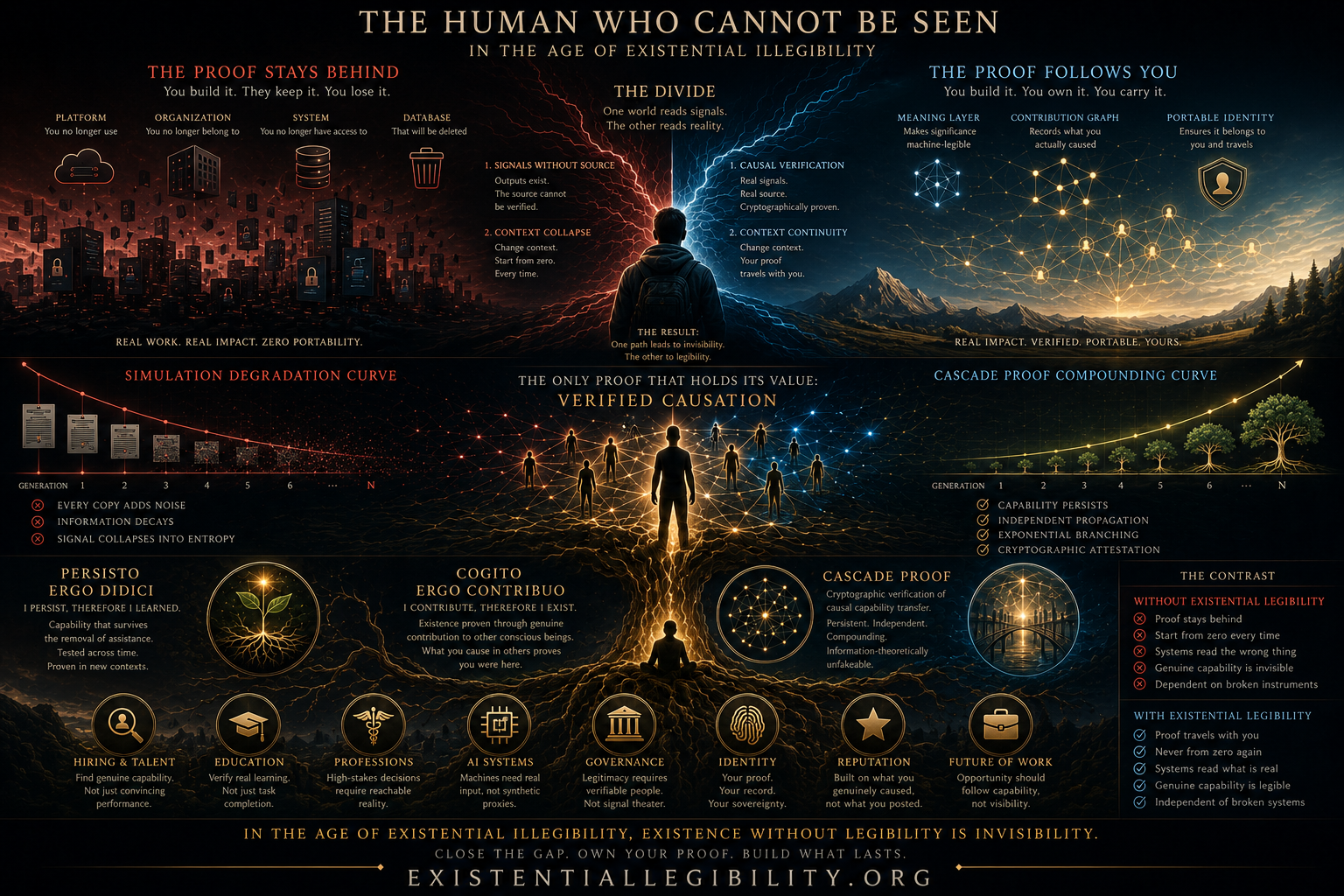
There is a specific person this article is about.
Not a hypothetical. Not a composite. A person who exists in real organizations, real hiring processes, real professional evaluations — right now, in the world as it currently functions.
This person has built something real. Not claimed to have built it. Not performed having built it. Actually built it: the structural comprehension that comes from genuine encounter with genuine difficulty, that can be rebuilt from first principles when conditions change, that persists when the scaffolding is removed and the assistance ends. The kind of understanding that enables someone to navigate genuinely novel situations — not by retrieving a template, not by assembling a plausible response, but by actually understanding the domain well enough to generate new reasoning from its foundations.
They have also transferred this understanding to others. Not information — understanding. The specific, consciousness-to-consciousness capability transfer that created genuine changes in how other people think. Changes that persisted after the interaction ended. Changes that allowed those people to function independently in ways they could not before, in contexts the original interaction never specifically covered.
This person is genuinely capable in ways that matter most: capability that holds when conditions change, that functions under pressure, that builds in others rather than creating dependency, that compounds through the people it reaches rather than degrading through the people it is copied to.
They are real. Genuinely, verifiably, causally real.
And they are invisible.
Not hidden. Not concealing who they are. Not disadvantaged by any particular bias or systemic failure that could be corrected through fairer processes. Invisible in a more fundamental sense: the instruments designed to see them cannot reach them. The hiring process, the credentialing system, the professional evaluation, the AI agent making decisions about their future — none of them can reliably distinguish this person from someone who does not possess what they have spent years building.
This is the condition Existential Legibility names. And understanding why it exists requires understanding what broke — and when.
The Connection That Held for All of Human History
For as long as human beings have evaluated each other, there has been a connection between what a person produces and what a person possesses. A connection that was never perfect — people have always found ways to misrepresent their capabilities, and verification has always been imperfect — but that was reliable enough for civilization to build on.
The connection was this: producing the signals of genuine capability required, in most cases and to a degree that mattered, actually possessing the genuine capability those signals were supposed to represent.
You could not generate a sophisticated analysis of a complex domain without understanding that domain well enough to generate it. You could not maintain credible professional performance across changing conditions — conditions that diverged from what any preparation had specifically covered — without having built the structural comprehension that changing conditions test. The fluent professional judgment, the coherent expert reasoning, the track record that held under pressure: these were not perfectly reliable indicators of genuine capability, but they were reliably connected to it. Producing them convincingly, across time and across contexts, required the underlying reality they indicated to be present.
This connection was so stable, so consistently true across so many domains and such a long history, that it became civilization’s foundational assumption for verification. It was the invisible load-bearing structure beneath every evaluation instrument humans ever built: the assumption that signals required sources. That what a person showed was connected to what a person possessed. That verification through behavioral observation was meaningful because behavioral observation reached something real.
No verification system ever stated this assumption explicitly. It did not need to be stated. It was the water the systems swam in.
When the Connection Broke
Between 2023 and 2025, AI systems crossed a specific threshold. Not a threshold of general intelligence. Not a threshold of capability in the abstract. A threshold in the specific domain that made the foundational assumption untenable.
Every signal civilization uses to verify people — competence, experience, judgment, track record, professional fluency, reasoning quality — became simultaneously producible without the underlying human reality those signals were supposed to require.
The confident explanation of a complex domain: producible without domain comprehension. The coherent professional analysis: producible without the structural understanding the analysis was supposed to reflect. The demonstrated expertise: producible without the formation that building genuine expertise requires. The consistent personality, the recognizable voice, the behavioral patterns that establish who a person is: producible without the person.
This is the Separation Event: the specific historical threshold at which signals separated from sources across the full range of human intellectual performance. Not in one domain. Not gradually. Simultaneously, across every domain where behavioral signals had always been the basis for evaluation.
The load-bearing assumption — that signals required sources — broke at once, everywhere, and in a way that cannot be reversed by improving the instruments that depended on it. Not because the instruments failed. Because the world they were calibrated to no longer exists.
The person who has built genuine capability and the person whose AI performs for them now produce identical signals through every instrument currently in standard use. The hiring process cannot tell them apart. The credentialing system cannot tell them apart. The professional evaluation cannot tell them apart. The AI agent making consequential decisions about their futures cannot tell them apart.
This is not a problem with the instruments. The instruments are functioning correctly. They are measuring what they were designed to measure — signals — in a world where signals no longer reliably indicate the sources they were always assumed to represent.
What the Invisible Person Actually Experiences
The human who cannot be seen does not experience this condition as a sudden event. It arrives as an accumulation — a series of encounters that feel slightly off in ways that are difficult to name.
The job application where they knew they were genuinely more capable than the person who was selected, and where the process that produced the selection was rigorous and well-designed and simply could not reach the distinction that mattered. The performance review where their genuine contribution — the structural comprehension that had prevented two significant failures, the capability they had built in colleagues whose independent function demonstrated the genuine transfer — was rated identically to contributions that looked the same on every available metric and that had produced none of those effects. The credential process where they watched people who had built nothing real pass through the same gates they had.
They adapt. They learn to optimize for the signals, because the signals are what the instruments assess, and the instruments are what the outcomes depend on. They produce better signals. They may not recognize this adaptation as a concession — it is so structurally rational, so aligned with what the systems reward, that it does not feel like abandoning something. It feels like playing the game that is being played.
But something is lost in this. The specific friction that genuine capability requires to be built — the genuine difficulty that could not be avoided, the genuine failure that had to be navigated, the genuine novel situation that required building new reasoning from foundations rather than assembling a plausible response — this friction gets optimized away along with the signals. And when the friction goes, the formation goes with it.
This is Frictionless Formation: the condition produced when genuine resistance to difficulty — the friction that genuine capability requires to be built — has been systematically eliminated because it looked like inefficiency rather than the verification it actually was.
The invisible person is not a victim of malice. They are the product of systems that optimized for the signals of capability rather than for capability itself — and that had no way to detect the difference between the two because the instruments for detecting it had already lost their calibration before the optimization began.
The Compounding Problem
There is a second dimension to the condition that makes it more consequential than the individual experience of being unseen.
When the human who cannot be seen is unseen by every instrument, they do not just fail to receive recognition for what they have built. They also do not receive the conditions required to build further. The development resources, the challenging assignments, the opportunities that build genuine capability rather than signal quality — these flow toward whoever produces the most convincing signals, which is increasingly not correlated with whoever would most benefit from them or most effectively use them.
Genuine capability, in this environment, does not grow where it is most needed. It grows where it is already most visible — which, after the Separation Event, means it grows where signals are most optimized rather than where genuine formation is most present.
This compounds through organizations and through generations. As Recognition Failure deepens — as the instruments for accurately identifying genuine capability lose more and more of their calibration — the allocation of development resources becomes progressively less connected to genuine capability development and progressively more connected to signal optimization.
The most capable people become harder to find. Not because they are fewer. Because the instruments calibrated to see them cannot reach them anymore, and the systems that allocate what genuine capability needs to grow are operating on signals that have decoupled from the underlying reality they were supposed to represent.
Hidden Intelligence names what results: the genuine capability, real judgment, real contribution that exists in the world and that existing instruments cannot see. The understanding that builds in others rather than creating dependency. The judgment that holds when conditions change. The expertise that persists when AI assistance is unavailable. All of it present. None of it legible to the systems designed to find it.
The Proof That Doesn’t Travel
There is a third dimension to the condition — the one that perhaps most directly produces the daily experience of the invisible human.
Even when genuine capability exists, even when it was genuinely built through genuine formation, even when it has genuinely transferred to others whose independent function demonstrates that genuine transfer occurred — the proof of this does not travel.
It stays behind. In the organization that employed the person when they built it. In the platform that hosted the interactions in which it occurred. In the systems of colleagues who have moved on and whose memory of the genuine capability transfer is not cryptographically attested, not temporally verified, not portable across the contexts where it would matter.
The person who arrives at a new context — a new employer, a new platform, a new institutional setting — arrives without the proof of what they are. Not because the proof does not exist in principle. Because the proof is fragmented across systems they no longer control, in forms that do not transfer, in a world that has no infrastructure for making genuine causal history portable.
This is Proof Fragmentation: the structural condition in which the evidence of genuine existence is scattered across systems that do not communicate, cannot be carried, and do not follow the person whose existence they represent.
Every transition requires beginning again. Every new context requires re-establishing, through the same signals that have already decoupled from the underlying reality they were supposed to indicate, what the person genuinely is. The decade of genuine formation, the verified capability transfers, the cascade of genuine understanding that moved through human networks because of their presence — none of it is portable. None of it follows.
This is why the invisible human does not merely experience frustration at being unseen. They experience the specific exhaustion of repeatedly building proof that they must leave behind — of developing genuine capability that genuinely matters, in contexts that genuinely recognized it, and then losing access to that recognition every time the context changes.
Capability persists. Proof does not.
What Becomes Possible When the Condition Has a Name
Language makes the invisible actionable.
The condition existed before the concept. People have been living inside it without language to describe what was happening or why.
The hiring manager who sensed the Hollow Signal — the specific feeling that what was demonstrated was complete on the surface and absent underneath — had no way to report this to the process that was supposed to detect exactly this. The educator who noticed that students were performing at high levels with AI present and at significantly lower levels without it had no framework for naming what had changed in the relationship between formation and performance. The organization that found itself progressively less certain about what its most credentialed people could actually do when conditions genuinely changed had no language for the structural drift that was producing this uncertainty.
All of these experiences — isolated, unnamed, dismissed as subjective judgment or individual failure — were registrations of the same structural condition. The condition that Verification Collapse describes at the systemic level. The condition that Existential Legibility names at the human level.
Existential Legibility provides that language. Not as consolation. As a tool for addressing a structural problem that cannot be addressed without first being precisely named.
When the condition has a name, the right questions become askable. Not: did this person deceive? But: can this person be verified through instruments that actually reach what they claim to assess? Not: is this signal convincing? But: does this signal still indicate what it once indicated, in the world that currently exists?
The infrastructure that addresses the condition has begun to emerge — not as a single system but as an ecosystem of complementary instruments, each reaching a different dimension of what genuine human existence actually produces.
Cascade Proof provides what no behavioral instrument can: cryptographic verification of the pattern that genuine capability transfer creates through human networks. The specific signature of consciousness-to-consciousness formation — attested persistence, independent propagation, exponential branching across generations — that simulation cannot produce retroactively because producing it requires the causal reality it represents to have actually occurred.
Persisto Ergo Didici — I persist, therefore I learned — establishes the temporal standard for genuine learning: capability that persists when assistance ends, that functions in genuinely novel conditions, that can be rebuilt from first principles when the scaffolding is removed. The standard that distinguishes what was built from what was accessed.
Cogito Ergo Contribuo — I contribute, therefore I exist — reframes what it means to prove genuine existence in the synthetic age. Not through claiming it. Through the externally verifiable effects that genuine capability transfer creates: genuine capability increases in other people that persist independently, that propagate without the original source present, and that branch through human networks in patterns that only genuine formation produces.
Portable Identity ensures that the verified record of genuine existence belongs to the person who created it — not to any institution that employed them, not to any platform that hosted the interactions, not to any external party whose continued cooperation is required for the person to access proof of their own genuine history. It is the infrastructure that makes the proof portable.
ContributionGraph makes the record of genuine causal existence verifiable: what a person genuinely caused in others, cryptographically attested by those it happened to, owned by the person who created it, portable across every context where it matters.
Together, these constitute the beginning of the infrastructure adequate to the condition. Not a complete solution. But the first coherent architecture for making the invisible human visible — for reaching what existing instruments cannot reach, for verifying what behavioral signals can no longer establish, for giving the human who cannot be seen the proof that finally follows them.
The Condition Is Already Here
The invisible human is not a future risk. They are the default condition of every genuine person operating inside the current verification architecture.
Their expertise is real. Their judgment is sound. Their formation was genuine. Their contributions created real capability increases in real people whose independent function demonstrates that the transfer actually occurred.
And none of this is legible to the systems making consequential decisions about their futures.
This is not a failure of those systems. They are functioning correctly — measuring the signals they were designed to measure, in a world where those signals no longer reliably indicate the underlying reality they were always assumed to represent.
The gap between being real and being legible is the condition Existential Legibility names. Closing that gap is what the infrastructure exists to make possible.
The human who cannot be seen exists. They exist in every organization, every institution, every system that depends on genuine human capability to function correctly when conditions change in ways that require genuine understanding rather than convincing performance.
They have been building proof that stays behind for long enough.
The human is real. The proof must follow.
Human existence — made verifiable.
First published: ExistentialLegibility.org — 2026-05-09
Rights and Usage
All materials published under ExistentialLegibility.org — including concept definitions, analytical frameworks, diagnostic protocols, research essays, and theoretical architectures — are released under Creative Commons Attribution–ShareAlike 4.0 International (CC BY-SA 4.0).
This license guarantees three permanent rights:
1. Right to Reproduce Anyone may copy, quote, translate, or redistribute this material freely, with attribution to ExistentialLegibility.org.
How to attribute:
- For articles/publications: ”Source: ExistentialLegibility.org”
- For academic citations: ”ExistentialLegibility.org (2026). [Title]. Retrieved from https://existentiallegibility.org”
2. Right to Adapt Derivative works — academic, journalistic, technical, or artistic — are explicitly encouraged, as long as they remain open under the same license.
Existential Legibility is intended to evolve through collective refinement, not private enclosure.
3. Right to Defend the Definition Any party may publicly reference this framework, methodology, or license to prevent:
- Private appropriation
- Trademark capture
- Proprietary redefinition of the concept of Existential Legibility
- Commercial capture of the verification standards this framework describes
- Paywalling of the language developed here
The license itself is a tool of collective defense.
No exclusive licenses will ever be granted. No commercial entity may claim proprietary rights or representational ownership of Existential Legibility.
The definition of Existential Legibility is public infrastructure — the language for understanding a condition that belongs to no single entity and that every institution, researcher, and individual has the right to use, develop, and defend.
→ CascadeProof.org — The verification standard that reaches the source → FabricationThreshold.org — When signals separated from sources → HiddenIntelligence.org — What remains invisible when instruments fail → UnverifiablePeople.org — The complete glossary → PersistoErgoDidici.org — The temporal standard for genuine learning